Movie Review: Amour

A few days ago, I watched a movie with my family called Amour. I had checked it out at the library a few months ago, but never got around to watching it. I finally decided I wanted to watch the movie. The movie took a while to get into, to be honest, and I had to get up and take multiple bathroom breaks (mostly because I woke up at an early hour and didn’t get much sleep) but I think by the end it became pretty suspenseful and I got more into it. If you haven’t seen the movie, it is about an elderly music teacher named Anne who suffers from a stroke and her husband, Georges, has to take care of her. Over the course of the time Georges is taking care of her, Anne’s declining health takes a toll on both her and Georges, to the point where Anne doesn’t have the will to go on living and Georges doesn’t want her to suffer anymore. It’s easy for me to think that I’m young and that illness and death are far away, but watching this film reminded me that illness and death is a reality for everyone, and it is painful to watch loved ones go through suffering. I think studying about life and death from a Buddhist perspective helped me have a deeper appreciation for life than I did before. At first, I just thought life was a waste and wondered what the point of my existence was, especially because at the time I had fallen in love with someone, and they were with someone else. I remember falling into deep despair at that time and wondering if I could go on with life if I could never be in a relationship with this person. But I remember reading a book called The Wisdom for Creating Happiness and Peace by the late Buddhist philosopher and author, Daisaku Ikeda, and he has a chapter called “Facing Illness.” He talks about the four sufferings in Buddhism: birth, aging, sickness and death, and how, through Buddhist practice, we can create meaning from these sufferings. He says that we should take practical measures to take care of our health, but he also says that health is not solely limited to the absence of illness. It’s really about how we can create value in our lives. He also says that even if someone has illness, their life is still worthy of respect. In a society that tends to shy away from talking about illness and death, this for me was a new perspective through which I could examine illness and death, because while we celebrate life and youth, illness and death are seen as things to be feared. Of course, it is incredibly painful when a loved one gets ill and dies, and going through the process of grief feels like a living hell most times. But as a young person, I think studying about life and death has been a huge benefit of my Buddhist practice because I have started to reflect on how I want to live my life. I was very jaded and cynical about life after experiencing heartbreak these past few years, but after practicing Buddhism I think that my perspective on life has changed. I want to appreciate every moment that I am alive, because I realize that life is precious, and I shouldn’t take it for granted.

Seeing Anne suffer from illness was pretty painful, and it was also painful for Georges. Him smothering her to death with a pillow was incredibly disturbing, but it just showed me that he also was starting to experience a lot of despair because his wife was in so much pain that she didn’t want to go on living. She had spent so much of her life as a pianist, but now that she is paralyzed on one side of her body, she can’t play it much anymore. So, when her student visits the house and leaves her a note expressing his sympathy to her, she feels sad because he gets to continue his art while she cannot continue to play. It reminded me of this movie I saw called Me Before You, because it’s about a young man named Will who becomes a quadriplegic after a seriously traumatic accident. When he becomes paralyzed, he loses his joy for life and starts to think about ending his life. He remembers that before he was quadriplegic, he could do all sorts of fun things with his life, especially traveling around the world. But he can’t do those things anymore, so he loses hope. And it’s painful for the young woman who is taking care of him, because she has this zest for life and to see this young man feeling hopeless and losing the will to live is painful for her. It is also hard for their grown-up daughter to see her mother suffering. When their daughter, Eva, tries to see her mom, Georges closes the door and prevents her from seeing Anne. When Eva finally sees Anne’s condition, she is in a lot of emotional pain. She tries to convince Georges to send Anne to a hospital, but Georges refuses because Anne doesn’t want to go to a hospital. This reminded me of this book I read called Being Mortal by Atul Gawande. My mother had recommended the book to me a couple of years ago. I read it and it was quite eye-opening to read about how we treat aging and death in American society. I had been learning about illness and death from a religious perspective, but I didn’t know much about how the elderly are actually treated in society. It addresses end-of-life care and how doctors can provide more support for patients approaching death. At first, it was an emotional challenge to read the book, because I have tried to avoid the topic of death for so long. But after so many of my close acquaintances and loved ones passed away from aging and illness, I began to want to learn more about illness and death and how to prepare for them. I don’t know if anything will ever fully prepare me for losing a loved one. I will still go through those stages of grief just like everyone else, but by having a deeper understanding of death, I have learned to embrace the process of grieving and understand that grief is not just something I cry about one day and get over the next. After my mentor, Daisaku Ikeda, passed away at 95, I was very, very sad and so was the rest of my Buddhist community. I still miss him so much, but I still read his writings because they give me courage, especially his book Discussions on Youth. I remember last year when a dear friend of mine passed away, I experienced tremendous grief. She was elderly, but she had such a vibrant spirit, and she always encouraged me to never give up. Experiencing grief reminds me of my own mortality and how I can better spend my time on this earth. Watching Amour presented an honest and real look at aging and dying and how challenging it can be for people to navigate these stages of life. It took me patience to get into the film, but I am still glad that I saw the film because it helped me understand that even though I am young, I need to appreciate the elderly people in my life before they pass away.

Amour. 2012. 127 minutes. Rated PG-13.
The Movie Lamb and Reflections on Grief

I just finished watching the movie Lamb. I had been wanting to see it for a while because it looked interesting, but I was at first put off because it was categorized as a horror movie, and I normally don’t like horror movies. I was pretty nervous about watching it because a huge reason I don’t watch horror is because I cannot deal with jump scares. Just something about stuff jumping out at you, especially if it’s a creepy doll or possessed supernatural force, just does not sit with me at all. In fact, I commend any of my friends who can sit through movies like Candyman and Child’s Play because I don’t think I would be brave enough to watch those movies. But I read more about the movie and people said there weren’t any jump scares, but that it was just disturbing. After reading the reviews and the parent’s guides, however, I finally just realized that I wouldn’t actually know whether I liked the movie (or could sit through it without screaming my head off in fear) until I actually watched it.

To be honest, the people who watched the movie were right. There were no jump scares. And I think because there are no jump scares, this is one of those movies that you really have to get into. And I was pretty into it. The only reason I had to keep getting up is because we are getting ready for the holidays and I was trying to get my room organized and do other stuff, but to be honest, this is one of those movies you really need to pay close attention to because there is mostly a lot of nonverbal communication. I think it was more sad than scary to be honest. I really didn’t think it was scary, but it was pretty unsettling. I think the last twenty minutes were pretty disturbing. I kept closing my eyes, thinking something was going to jump out on the screen, but to be honest closing my eyes every five seconds with my heart racing, thinking, Something’s going to jump out, pretty much ruined my first viewing of this film. I think I would need to watch it again because while closing my eyes and anticipating jump scares, I missed out on enjoying the actual experience of watching this movie. I wouldn’t mind watching it again though, because there were definitely some parts I missed or didn’t quite understand about the plot. I think reading the Wikipedia plot after seeing the film is helping me process and understand parts that I missed.

If you haven’t seen Lamb it is about a couple named Maria and Ingvar living in rural Iceland who don’t have any children of their own, but they help birth one of the babies of their sheep and they end up taking the sheep’s child as their own child. At first things are going well. They name the child Ada and take her for walks and play with her and treat her like any human baby (Ada is born half human, half lamb). However, their parenting comes at a steep price. Maria kills Ada’s mother when Ada’s mother won’t stop bleating for her child at the window (honestly, until it was mentioned later in the film, I totally didn’t realize that Maria had killed Ada’s mother. But then again, they were all sheep so I couldn’t really tell who was who) Maria constantly pushes Ada’s mother away when Ada’s mother is clearly calling for her child back, until finally she snaps and just kills her. Honestly this part was really hard to watch, even before I realized that the sheep was Ada’s biological mother. Maria and Ingvar continue to take care of Ada without Ada knowing Maria killed her mother, and then things take a turn when Petur, who is Ingvar’s brother, comes to stay with them. Not only doesn’t Petur make sexual advances towards Maria, but he also questions whether Maria and Ingvar should be keeping Ada. Looking back, at first I was skeptical about his skepticism, but after thinking about what happens at the end of the film, it made sense that he was pretty suspicious. Maria and Ingvar act like nothing bad is going to happen, and Maria, Ingvar and Petur get drunk one day while watching a sports game and start dancing around the room. Ada is probably super overstimulated by all their yelling and drunken-ness, so she leaves the room and she goes outside. She sees the dog whimpering and hears heavy breathing and sees an unknown entity before her (they don’t show who it is yet) and the entity kills the dog off screen. Ada, Maria and Petur are still oblivious, and Petur continues to try and kiss Maria, and she finally locks him in a closet so he won’t get to her anymore, loudly playing classical music on the piano to drown out his yells. The next day, Maria takes Petur to the bus stop so he can leave, and meanwhile Ingvar takes Ada for a walk, not knowing that his life will change forever, and not in a good way. The entity, who is a ram human hybrid and the biological father of Ada, kills Ingvar with his shotgun and takes away Ada. Ada is really sad when Ingvar dies, but she has no choice but to go with her biological father. They leave, and when Maria arrives it is too late and Ingvar dies right before her eyes. She is literally alone with her grief.

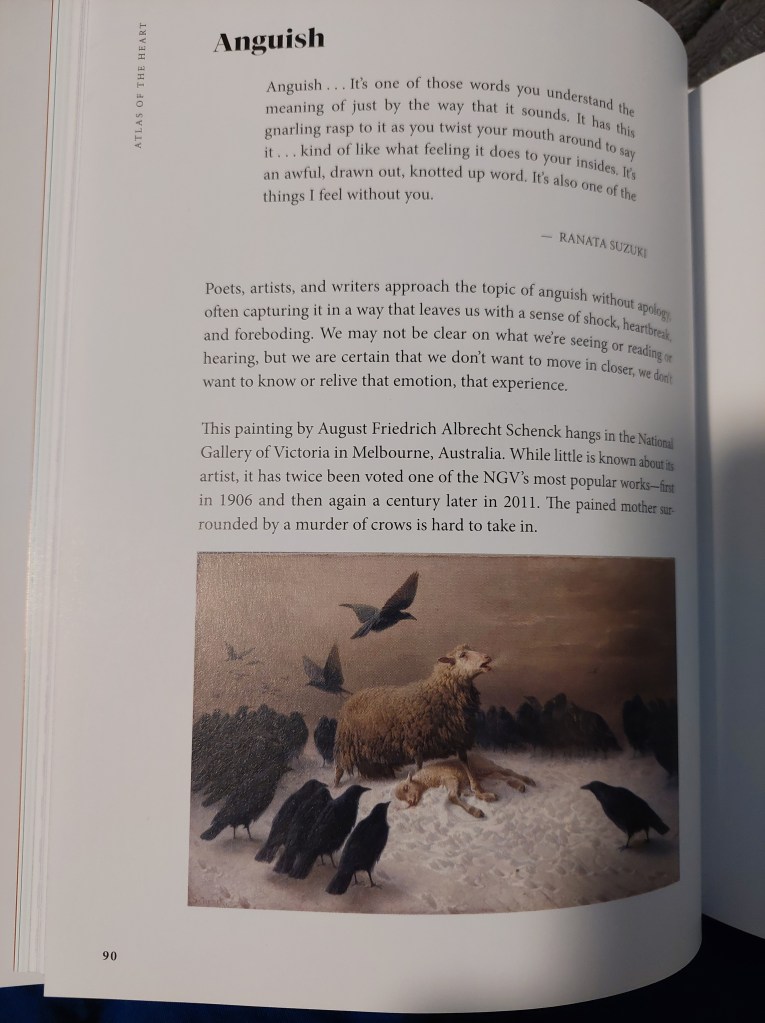
Grief and the influence it has on our lives is a huge theme of this movie. While thinking about the film, I thought about this painting I saw in Brene Brown’s book Atlas of the Heart, in which she breaks down and explains a wide range of different feelings and emotions we have in certain situations, such as belonging, joy, and anxiety. One of these is called anguish, and on page 90 she shows a painting by August Friedrich Albrecht Schneck called Anguish, which depicts a mother sheep grieving the loss of her dead lamb child, while surrounded by a group of crows. Honestly when I first saw that painting I was pretty emotional, not just because I am a huge lover of animals but because anguish and grief are very real and very painful experiences. I am not sure whether Ada ever found out that Maria killed her mother, or whether Ada’s biological father even knows either. I’m sure the movie left that up to interpretation. But that painting showed me that animals experience emotions like us, and that they’re not just these dumb unfeeling creatures. I think as I processed the film, at first I didn’t know what was going on with the sheep bleating out the window at Ada all the time, but then Petur tells Maria that if she doesn’t let him hit on her, he will tell Ada that Maria killed Ada’s mother, and that’s when I realized, Oh, shit. That was Ada’s mother. That must have been pretty painful for Ada to be so young and yet lose her mother like that. I looked up more about the Anguish painting, and there is a 1885 version in which, instead of the mother sheep grieving her young’s death, the young sheep grieves over his mother’s dead body, surrounded by the same crows.

Full credit: p. 90, Atlas of the Heart: Brene Brown. Anguish (Angoisse) (c. 1878) by August Friedrich Albrecht Schenck. National Gallery of Victoria, Melbourne, purchased 1880.

Both of these versions left my heart feeling incredibly heavy. Losing one’s parents, child or any other loved one is an incredibly painful experience, no matter how one processes grief or expresses their grief. I just think about The Writings of Nichiren Daishonin because in many of his letters he talks about grief and losing loved ones, because many of his followers dealt with the loss of their loved ones. He encourages them to continue practicing Buddhism and overcome their challenges, but he also acknowledges that grief is a human experience and is also incredibly painful, even for the most stoic of people. To be honest, I am getting pretty emotional writing about this and thinking about the Anguish painting and the film because losing people you love really does hurt, and while Ada grieved over her adoptive father (Ingvar’s) death, I wonder how she is going to be able to process learning about her mother’s death as she grows up in the future, or whether she is going to go through life not knowing that her mother got killed. It was painful for me to watch Maria grieve over her husband, Ingvar’s death, but in a way, her grief was connected to Ada’s biological mother’s grief, even if Maria just thought Ada’s mom was just some annoying dumb animal who kept making loud bleating noises at the window. Of course, I may be overthinking it. After all, these people lived on a farm, probably hours from a grocery store, and they had to get their lamb chops from somewhere (I’m saying this as someone who has been a lifelong animal lover and a vegan for fifteen years). But it is still painful because Ada’s mom’s grief at not getting her child back was not really any different from Maria’s grief at losing Ada (and Ingvar.) In the book Atlas of the Heart, Brene Brown describes the feeling of anguish in a way that just ripped at my heart strings (“anguish is an almost unbearable and traumatic swirl of shock, incredulity, grief and powerlessness.” Brown 91)

She also explains that anguish can be physically tormenting as well. When we experience anguish, we have trouble breathing, focusing, really doing anything, and it can literally make us sink into the ground. I remember when my mentor, Daisaku Ikeda, passed away. It was November 18, and my mother was going to write to him. She had worked so hard on this letter the night before, and I remember the morning I checked my phone and found on the WhatApp group the news from other SGI members about his passing, I couldn’t breathe, my heart raced and I literally felt I could not do anything. Walk, get up, go to the bathroom. Nothing. I felt a huge stone thud in my body, and my head spun and I began to feel my life was no longer in my control. Now of course you will say, Hold up. Was it really that painful? Yes. It was, reader. It very much was. I woke up to do my morning chanting of Nam-myoho-renge-kyo to my Buddhist altar, the Gohonzon, and my dad walked in and told me with a pained expression he found out the news about Daisaku Ikeda’s passing, too. My mother was going to sleep in, and I was anxiously wondering what to tell her, because I was still very much in shock, too. When we finally told her that morning, she froze, and her lips trembled and she leaned down and her body racked with sobs. She retrieved the letter she was going to send to Mr. Ikeda and read to us aloud, and as she read, she clutched her mouth to hold back the sobs as tears streamed down her cheeks and she felt like she was going to collapse. My father and I cried with her. We just were in such shock. We knew he was 95. But it was still deeply painful. We scheduled a chanting session at the Buddhist center and everyone came and was deeply pained. I remember the next morning before going to the center for my Byakuren shift reading Daisaku Ikeda’s encouragement, and still in shock, collapsing on top of the kitchen counter and emitting loud long wails as tears racked my body and I lost control of my expression of grief. My mother rubbed my shoulders as I was completely beside myself. I then went to the restroom and my shoulders heaved and heaved and I just could not stop crying. I collapses physically and I felt I wasn’t actually going to make it to the center that day. Even after I wiped my tears, the grief was still very much present, not just with me but with everyone who came to the center that day. The anguish everyone felt over the passing of our mentor was painful to witness and experience, and I remember feeling so alone in my grief until I remembered that everyone was still grappling with his passing and that grief is not something you can just rush through or push under the rug. Of course, you don’t have to let it consume you, but I have learned that everyone processes grief differently and there is no arbitrary time table for people to grieve.

I think watching movies during this time of grief has been a reminder that grief is a human experience and that I shouldn’t feel like I am going through it alone. The other day, I watched The Crown season 6 and it shows the grief that Charles experiences when he finds out that his ex-wife, Diana, died in a car crash in Paris. When he sees her body during the autopsy, he experiences serious anguish and he sees Diana in a vision as if she was still alive, and what she tells him fills him with deep regret at the way he treated her for so many years. Even after he was talking about how happy he was with Camila, Diana still had a profound impact on his life and so it was painful and shocking to find out about her death. Dodi’s dad, Mohamed Al-Fayed (who actually passed away this year) also experiences profound grief when he learns Dodi died with Diana in the car crash. At the funeral for Dodi he is in so much emotional pain and wails in anguish when he goes into the examining room and sees his son’s body after the autopsy. Mohamed also imagines Dodi talking to him, saying how he failed his father, and he breaks down and tells Dodi before he disappears that he didn’t fail him and that he really misses him. This showed me that even though Diana had a complicated and destructive marriage where Charles didn’t value or respect her, and even though Dodi had a relationship with his father where his father placed heavy expectations on him and demeaned him if he failed to meet those expectations, at the end of the day, the grief Charles and Mohamed both experienced reminded them of how much they actually loved the people they lost and how painful it was to lose the people you love.