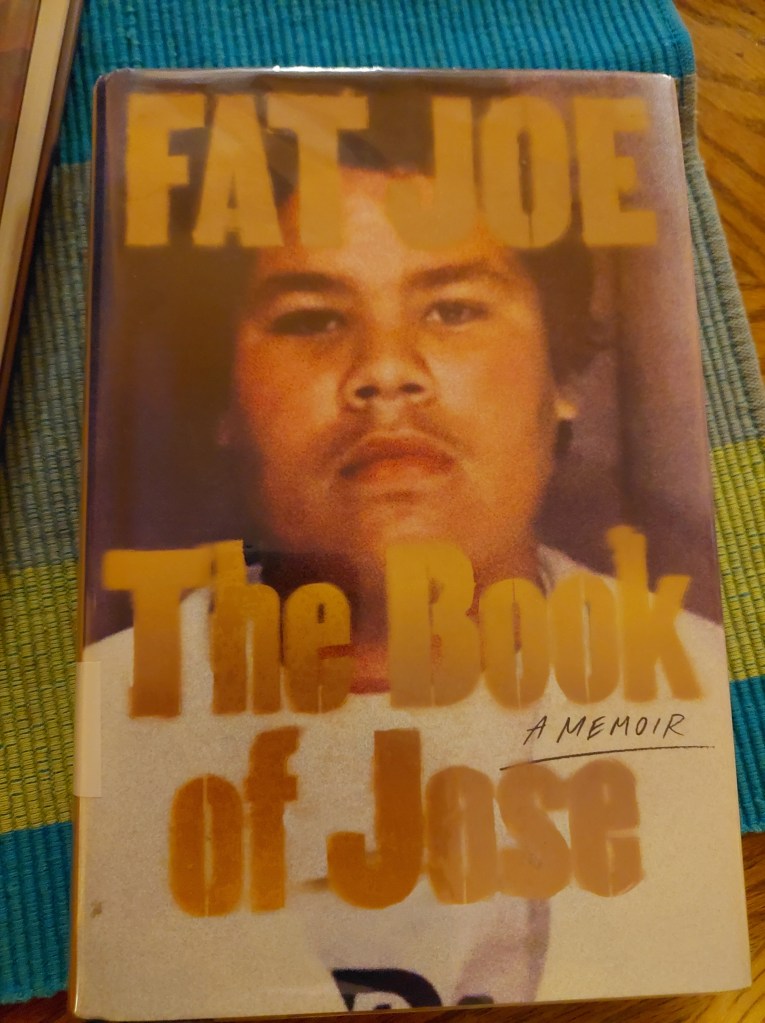
Book Review: The Book of Jose

I was browsing the local library, and I went into the adult non-fiction section. They had a section of books about music and musicians, and some of these books were memoirs that musicians have written about their personal lives and their careers. To be honest, I didn’t grow up listening to a lot of old-school rap music. Whenever I would listen to hip-hop on iTunes, I would want to listen to the clean versions that did not have any swearing because I thought swearing was bad and I didn’t want to repeat the explicit language on the album. When I was in my orchestra class in sixth grade, there was this Black kid named Christopher Weaver and he was showing his friend, a Black kid named Austin Stevens, a music CD disc. The disc cover had an African American baby on it just sitting there against a white background. In the right corner there was this sticker that read in big capital letters: PARENTAL ADVISORY, EXPLICIT CONTENT. I was so religious about avoiding CDs that had that big old black and white sticker on them that I was rather taken aback when I saw that Christopher had that CD in his hand.

“What’s that?” Austin asked him.

“A bad CD,” Christopher told him.

I remembered reading in a music CDs catalog around that time (I think it was either Best Buy or Fry’s Electronics. I cannot remember) and they were selling various music CDs. A few of them included Follow the Leader by the rock band Korn, which shows a bunch of children playing hopscotch as a little girl runs towards the edge of a cliff and proceeds to jump off of the cliff. There was another Korn CD called See You on the Other Side that had a disturbing-looking album cover of this pale frightened boy holding a decapitated teddy bear staring out as a rabbit places a crown on him and as a horse holds the decapitated teddy bear’s head. And then I saw an album in the catalog of an African American baby sitting in this empty white void, and the title was Ready to Die. At first, I thought that Ready to Die was a heavy metal rock album similar to Korn’s music. But then I finally reached my 20s and realized that Ready to Die was a hip-hop album by the late and great Christopher Wallace, also known as The Notorious B.I.G., also known as Biggie Smalls, and also known as just Biggie. Like I said, I did not grow up listening to a lot of old school hip-hop. The only times I would hear hip-hop was from school dances or kids rapping the lyrics. If I did hear rap music on the radio, it was always censored. I grew up with Soulja Boy, T-Pain, and Ludacris. I did not grow up listening to The Notorious B.I.G., Tupac and other 1990s rappers until I was older. During my sophomore year of college, I enrolled in a course called Introduction to Black Culture by a really sweet man named Kevin Quashie. The course was an introductory class in the Afro-American Studies department (they changed the name to Africana Studies around my junior or senior year) and we watched movies such as Spike Lee’s Bamboozled and studied artworks by African American painters in the 20th century. We also read a graphic and disturbing excerpt from a non-fiction book about the lynching of African Americans during the 1900s. One of the parts of the course I remember, though, was the unit on hip-hop and rap music. In class one day we listened to songs like “Lose Control” by Missy Elliott and “We Don’t Need It” by Lil’ Kim and Lil’ Cease and also studied the origins of hip-hop and pioneers of hip-hop like Grandmaster Flash and the Furious Five. After the course, I started exploring more hip-hop records out of curiosity. As I have gotten older, I have gained a deeper appreciation for hip-hop music that came out in the 1990s and 2000s. Hip-hop is part of my African American heritage and it has provided solace and inspiration for a lot of young people. I consider Tupac and Biggie Smalls to be poets and even though the lyrics of the music are misogynistic and homophobic, I have to remember that at the time that these artists were rapping, there was a lot of anti-gay sentiment and the AIDS crisis in the 1980s disproportionately impacted LGBTQ people, causing them to face scapegoating and ostracism from American society. Hip-hop emerged during the 1970s and 1980s so it coincided with the sexual revolution and the AIDS crisis. Art is a product of what is going on in society, and while artists have used their music to speak to racial discrimination and injustice, they have also used their music to speak negatively about groups that they perceive to be a threat. This also comes from a lack of education about the LGBTQ community because unlike now, where we have social media and online resources that non-profits such as The Trevor Project and The Human Rights Campaign have provided for people, people lacked the education and resources to meet the LGBTQ community where they were at and provide them with the support and resources that they needed. It does not in any way justify the use of bigoted language such as the F word and the D word, but looking at the use of homophobic slurs in hip-hop from the context of history helped me understand why rappers use this kind of pejorative language in their music.

I knew about Fat Joe when I was younger, but because I didn’t like songs with explicit language (I was worried about repeating it), I listened to the clean version of “Lean Back” by Terror Squad. When I finally got over my days as a language prude, I decided to pop in some rap music and listen to the full explicit lyrics. Recently, after getting Spotify Premium, I listened to full albums, and some of these albums were hip-hop albums. As I read The Book of Jose, I became curious about Fat Joe’s music. There was an album of his that came out in 2005 called All or Nothing, but I never listened to it. A month ago, I listened to it on Spotify and really love the flow of Fat Joe’s rhymes. As a queer person, I did wince each time I heard him use slurs like the F-slur, but I did my best to listen to as much of the album as I could.

There was a lot about Fat Joe’s history that I didn’t know about. He was born and raised in the Bronx in New York City and he grew up in poverty and around a lot of gun violence. What saved him was hip-hop music. He started to collaborate with other rappers and put himself out there and eventually he became a number one-selling hip-hop artist. He not only discusses his career, but he talks about meeting his wife, his children and his family. It was sad to read about the death of his friend and fellow rapper, Big Pun. To be honest, reading this book reminded me of this piece of writing that was published in the 1200s called “The Eight Winds.” It is by a Japanese Buddhist reformer named Nichiren Daishonin and it discusses how important it is to not let external influences like fame, criticism, suffering and pleasure, cause Buddhist practitioners to lose faith in their Buddhist practice. Practicing Buddhism reminds me time and again that even if I achieve fame or success in my music career, I cannot let it get to my head. Also, I need to give back to my community because that is the best way to express my gratitude for all of the wonderful music education and opportunities that I received growing up. I also need to be true to myself and not think that I am better than people just because I have trained for so long as a classical musician. The minute I act like my shit doesn’t stink, it’s over. I’m fucked.

Book Review: Born a Crime by Trevor Noah

A few days ago, during my lunch break at work, I finished a memoir by South African comedian Trevor Noah titled Born a Crime: Stories from a South African Childhood. I love Trevor Noah, and I loved watching him when he was on The Daily Show on Comedy Central. When people had to go into quarantine during 2020, the show became The Daily Social Distancing Show and Trevor Noah did Zoom chats with celebrities and the other comedians on The Daily Show like Roy Wood, Jr., Desi Lydic, Dulce Sloan and Lewis Black. Watching The Daily Show gave me a deeper understanding of global issues and pop culture issues that I would not have otherwise looked into, and Trevor did it with a funny twist. One of my favorite episodes was when Trevor played a song on the keyboard before we all had to go into quarantine, and he sang to the studio audience about what he was going to miss about having a live studio audience (due to the emergency declaration, late-night shows couldn’t have live audiences and had to film their shows via Zoom/ videoconferencing). He sang about how he was going to miss the people with the “weird-ass laughs”, the people who explained the show to other audience members, and a guy who wanted to hear about their home continent of Africa (the guy shakes his head and shouts from the audience, “Tell them about Uganda!”) When he left The Daily Show, I was pretty devastated at first but later came to understand that he left because he wanted to avoid burnout and also do other things with his life. That is totally understandable looking back, because late night TV is a serious job with serious demands. I don’t know what time late-night TV hosts like Jon Stewart, Jimmy Kimmel, or Stephen Colbert actually go to bed, or what time they have to film their shows, but it sounds like an intense job even though they clearly love what they do.

I remember that Trevor’s memoir, Born a Crime, came out in 2016, and when I went to a summer music camp, I saw this boy reading the book and told myself that I would get around to reading it eventually. This past year I read a lot of memoirs by actors and comedians like Seth Rogen, Josh Peck, Aparna Nancherla, and Busy Phillipps. So, I was very glad that when I went to my local college library, they had a hardcover copy of Born a Crime waiting on the shelf, just for me. I immediately checked it out along with some other books (since I am a community patron, I am only allowed to check out up to five books). I am so glad I got to finally read this book, Born a Crime. Even though we learned about apartheid in South Africa in my world geography and history classes in high school, reading an account by someone who lived through apartheid is a completely different experience than reading about it in a high school textbook. There is only so much that the school curriculum can cover during the school year, and so even though we learned about the history, political systems and cultural traditions of African countries, reading a first-hand account by someone who went through it was so different from just reading about South Africa in a textbook. For instance, in the memoir Trevor talks about the different languages that people in South Africa speak. To be honest, the only language I was familiar with before reading the book was Afrikaans. In seventh grade during the springtime, I went to Washington, D.C. for an ambassador program called People to People, and there was one girl on the program, a young white woman named Alta, who was from South Africa. She wasn’t the first person I met who was from South Africa. In elementary school, there were these two fraternal twins who were born in South Africa and came to the U.S. for public school, and one of the members in my Buddhist organization was from South Africa. But still, I had only met a few people from South Africa up until that point, so it was pretty interesting getting to meet someone on the program from South Africa, and she was also the only one in our group who was from outside of the United States. Alta also taught us how to say numbers in a language spoken in South Africa called Afrikaans, and it was my first time learning anything in Afrikaans. In my sophomore year of college, I took a class called African Popular Music, and it was such a great class because I got to listen and expose myself to different music styles in African countries. The course taught me that music in Africa doesn’t exist in a monolith. There are various styles within the realm of African music. We had to do a final project for the course, and one of the groups presented on a rap rave duo called Die Antwoord, who hail from South Africa. I didn’t know anything about the group, but the presenters showed a very explicit music video that they did for this song called “Evil Boy” (to this day, I still don’t have the stomach to watch it) and the people giving the presentation warned us in the class before showing the music video that it was explicit. I ended up closing my eyes during the music video because I have a weak stomach, but I could still hear Yolandi Visser’s high-pitched voice scrape like nails on a chalkboard, and it was definitely a sound I wasn’t used to. I am a Motown/ Anita Baker kind of girl, and haven’t listened to any rap rave music, so listening to Die Antwoord was a totally new (and rather uncomfortable) experience for me. After the group presented on Die Antwoord, I decided to look up the group on Wikipedia and found that the duo frequently used blackface in their music videos (they are both white South Africans). In America, blackface has a long history of being used in minstrel shows to mock Black people, and there are 21st century celebrities like Julianna Hough and Sarah Silverman who have used blackface and have faced significant backlash for doing so. Studying about the history of minstrelsy and blackface in America made me curious about how other countries perceive blackface.

Reading Born a Crime gave me a better understanding of South Africa’s complicated history with racism and colorism under apartheid. Trevor Noah was born to a Xhosa mother and a white Swiss/ German father, and under apartheid his mother and his father weren’t allowed to be seen together, so Trevor became much closer to his mom than he did his dad. Even when he visited his dad as an adult, his dad still didn’t share much about his past childhood or much about himself as a person, so Trevor’s biological dad had always been a mystery. His mom, however, is outspoken, religious and independent. She is a single parent raising Trevor by herself, but Trevor’s mother never wants to elicit pity from anyone or feel sorry for herself, and she instills that in Trevor as well, telling him that they are not victims who people need to feel sorry for. For those who aren’t familiar with apartheid in South Africa, it was a policy of racial discrimination and segregation that the white South African government established to oppress Black South Africans, who made up the majority of South Africa’s population. Long after apartheid was repealed thanks to the painstaking efforts of the late Nelson Mandela, the policy still has done lasting damage to the social fabric of the country and people are still left having to grapple with this 20th century segregation policy that discriminated against black people and gave white people access to privileges not afforded to black South Africans. The first time we studied about apartheid was when I watched the Disney Channel Original movie called The Color of Friendship, which is about a friendship that forms between a white South African girl and a Black family in America. However, I watched the film a long time ago when it first came out, so I would have to watch it again. Reading Born a Crime truly showed me how complicated and messy the system of apartheid truly was. Like a lot of biracial and multiracial kids, Trevor struggled to figure out whether he was black or white, and in South Africa, under apartheid, there was also a racial classification called “colored.” Growing up, Trevor faced loneliness and bullying at school and didn’t know which group he fit in with, so he had to spend a lot of time on his own.

I think the scene that was the hardest to get through, though, was when Trevor’s brother, Andrew, calls him to tell him that Trevor’s stepfather, Abel, shot his mother in the back and head for divorcing him and remarrying. When Trevor’s mom and Abel first meet while Abel is working as a car mechanic, Abel comes off as this charming guy, but Trevor doesn’t have a good feeling about him, and when his mom tells him that she and Abel are getting married, he tells her that she probably shouldn’t. As their marriage progresses, Trevor witnesses Abel physically abusing his mother and come home drunk. Even when Abel beats her, Trevor’s mom assures him that it is okay and she stays married to Abel. Abel grew up in a traditional household where the men run everything and the women and daughters have to cook and clean for the men. Trevor’s mom, however, is an independent woman so she doesn’t agree that she has to always be at Abel’s beck and call. Trevor’s mom tries to help pay off the debt that Abel accumulates running the mechanic business, but finally she gets fed up with Abel shirking his responsibility to pay the bills and take care of the kids and divorces him. One day, after Trevor’s mom and her new husband come back from church, Abel shoots a gun at them, and Trevor’s mom suffers near-fatal injuries and has to be taken to the hospital. Even though she survived, I remember just breaking down in tears reading that scene because I haven’t been in a situation where I have had to witness domestic violence. I guess that is why reading about domestic violence is so important, though, because I have to be aware that domestic violence is a serious reality that a lot of (mostly) women face. When I finally finished the book, I couldn’t stop crying and thankfully I had closed the door of my office because if I didn’t, my coworkers would have probably heard my loud sniffles and sobs from down the hall. The book truly had an impact on me.

Honestly, reading about Trevor’s relationship with his mom really made me want to appreciate my own mother. As a teenager, I acted like such a spoiled brat, and even when I moved back home in my 20s, I would still throw tantrums and snap at my mom and slam doors even when I knew deep down that I was yelling at the very person who birthed me, fed me food, and put a roof over my head for more than twenty years. I grew up pretty privileged, even though I didn’t grow up in a family of millionaires or with generational wealth. I went to a school with an incredible fine arts program, and was able to take cello lessons every week, and even after graduating, my dad paid for me to take these $100 cello lessons every week. However, looking back, I really struggled to have appreciation for the circumstances I grew up in. I think that is why I love reading books, because there is a quote on my calendar (it’s a calendar with photos of libraries around the world on it) by James Baldwin, and the quote reads “you think your pain and your heartbreak are unprecedented in the history of the world, but then you read.” That quote really hit hard, and reminded me why I love to read so much, because reading opens me up to different perspectives from authors around the world and helps me learn about different circumstances that people grew up in. Learning about the system of apartheid in South Africa from reading Born a Crime was eye-opening. It’s easy for me to just focus on the history of Jim Crow and racism in a US context, which of course is important to learn about, but reading Born a Crime reminded me that it’s important to learn about the history of discrimination and human rights abuses in other countries. Even though South Africa was predominantly Black, a white minority put together this system so that they could oppress the Black majority. Racism and other forms of prejudice like xenophobia, homophobia, and transphobia stem from fear and ignorance, and educating myself about this history is important because history repeats itself.

Overall, the book was an eye-opening, poignant and raw reading experience, and I highly recommend it for anyone who hasn’t read it yet.