Yesterday, I was browsing through the news, and on the top of the page, one of the headlines read that Sophie Kinsella, one of my favorite authors, died at age 55. Even though I knew about her cancer diagnosis from reading about her social media posts, it was still shocking. Death is just one of those things that is really hard to process, even if you know that the person was dealing with a terminal or serious illness and didn’t have much time left in this world. Sophie Kinsella was one of my favorite authors. She wrote this book called Confessions of a Shopaholic, which is about this young woman in England named Rebecca “Becky” Bloomwood who has a compulsive addiction to shopping. I have read all of the books in the Shopaholic series except for Christmas Shopaholic, which I checked out from the library weeks ago but haven’t even started yet. I am glad that I still have renewals on it because this holiday season, I really could use a big old hug from my fictional friend, Becky Bloomwood. Rest in Peace, Sophie, and thank you for all of the literature and laughs.
Tag: books
Book Review: The Book of Jose
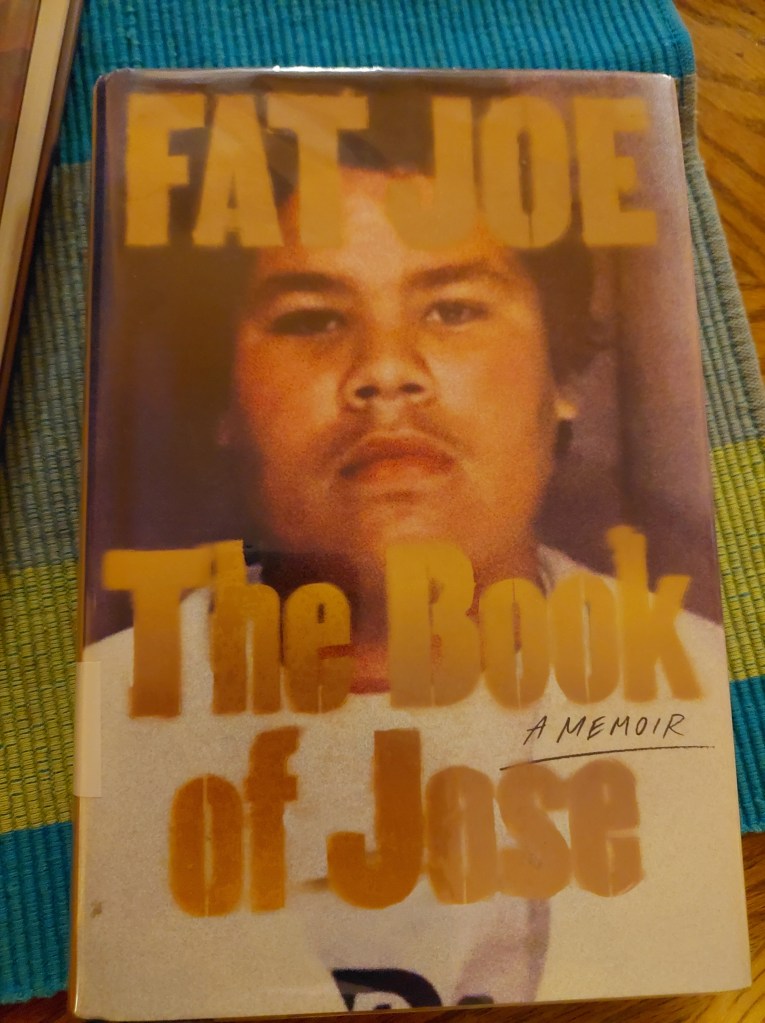
I was browsing the local library, and I went into the adult non-fiction section. They had a section of books about music and musicians, and some of these books were memoirs that musicians have written about their personal lives and their careers. To be honest, I didn’t grow up listening to a lot of old-school rap music. Whenever I would listen to hip-hop on iTunes, I would want to listen to the clean versions that did not have any swearing because I thought swearing was bad and I didn’t want to repeat the explicit language on the album. When I was in my orchestra class in sixth grade, there was this Black kid named Christopher Weaver and he was showing his friend, a Black kid named Austin Stevens, a music CD disc. The disc cover had an African American baby on it just sitting there against a white background. In the right corner there was this sticker that read in big capital letters: PARENTAL ADVISORY, EXPLICIT CONTENT. I was so religious about avoiding CDs that had that big old black and white sticker on them that I was rather taken aback when I saw that Christopher had that CD in his hand.
“What’s that?” Austin asked him.
“A bad CD,” Christopher told him.
I remembered reading in a music CDs catalog around that time (I think it was either Best Buy or Fry’s Electronics. I cannot remember) and they were selling various music CDs. A few of them included Follow the Leader by the rock band Korn, which shows a bunch of children playing hopscotch as a little girl runs towards the edge of a cliff and proceeds to jump off of the cliff. There was another Korn CD called See You on the Other Side that had a disturbing-looking album cover of this pale frightened boy holding a decapitated teddy bear staring out as a rabbit places a crown on him and as a horse holds the decapitated teddy bear’s head. And then I saw an album in the catalog of an African American baby sitting in this empty white void, and the title was Ready to Die. At first, I thought that Ready to Die was a heavy metal rock album similar to Korn’s music. But then I finally reached my 20s and realized that Ready to Die was a hip-hop album by the late and great Christopher Wallace, also known as The Notorious B.I.G., also known as Biggie Smalls, and also known as just Biggie. Like I said, I did not grow up listening to a lot of old school hip-hop. The only times I would hear hip-hop was from school dances or kids rapping the lyrics. If I did hear rap music on the radio, it was always censored. I grew up with Soulja Boy, T-Pain, and Ludacris. I did not grow up listening to The Notorious B.I.G., Tupac and other 1990s rappers until I was older. During my sophomore year of college, I enrolled in a course called Introduction to Black Culture by a really sweet man named Kevin Quashie. The course was an introductory class in the Afro-American Studies department (they changed the name to Africana Studies around my junior or senior year) and we watched movies such as Spike Lee’s Bamboozled and studied artworks by African American painters in the 20th century. We also read a graphic and disturbing excerpt from a non-fiction book about the lynching of African Americans during the 1900s. One of the parts of the course I remember, though, was the unit on hip-hop and rap music. In class one day we listened to songs like “Lose Control” by Missy Elliott and “We Don’t Need It” by Lil’ Kim and Lil’ Cease and also studied the origins of hip-hop and pioneers of hip-hop like Grandmaster Flash and the Furious Five. After the course, I started exploring more hip-hop records out of curiosity. As I have gotten older, I have gained a deeper appreciation for hip-hop music that came out in the 1990s and 2000s. Hip-hop is part of my African American heritage and it has provided solace and inspiration for a lot of young people. I consider Tupac and Biggie Smalls to be poets and even though the lyrics of the music are misogynistic and homophobic, I have to remember that at the time that these artists were rapping, there was a lot of anti-gay sentiment and the AIDS crisis in the 1980s disproportionately impacted LGBTQ people, causing them to face scapegoating and ostracism from American society. Hip-hop emerged during the 1970s and 1980s so it coincided with the sexual revolution and the AIDS crisis. Art is a product of what is going on in society, and while artists have used their music to speak to racial discrimination and injustice, they have also used their music to speak negatively about groups that they perceive to be a threat. This also comes from a lack of education about the LGBTQ community because unlike now, where we have social media and online resources that non-profits such as The Trevor Project and The Human Rights Campaign have provided for people, people lacked the education and resources to meet the LGBTQ community where they were at and provide them with the support and resources that they needed. It does not in any way justify the use of bigoted language such as the F word and the D word, but looking at the use of homophobic slurs in hip-hop from the context of history helped me understand why rappers use this kind of pejorative language in their music.
I knew about Fat Joe when I was younger, but because I didn’t like songs with explicit language (I was worried about repeating it), I listened to the clean version of “Lean Back” by Terror Squad. When I finally got over my days as a language prude, I decided to pop in some rap music and listen to the full explicit lyrics. Recently, after getting Spotify Premium, I listened to full albums, and some of these albums were hip-hop albums. As I read The Book of Jose, I became curious about Fat Joe’s music. There was an album of his that came out in 2005 called All or Nothing, but I never listened to it. A month ago, I listened to it on Spotify and really love the flow of Fat Joe’s rhymes. As a queer person, I did wince each time I heard him use slurs like the F-slur, but I did my best to listen to as much of the album as I could.
There was a lot about Fat Joe’s history that I didn’t know about. He was born and raised in the Bronx in New York City and he grew up in poverty and around a lot of gun violence. What saved him was hip-hop music. He started to collaborate with other rappers and put himself out there and eventually he became a number one-selling hip-hop artist. He not only discusses his career, but he talks about meeting his wife, his children and his family. It was sad to read about the death of his friend and fellow rapper, Big Pun. To be honest, reading this book reminded me of this piece of writing that was published in the 1200s called “The Eight Winds.” It is by a Japanese Buddhist reformer named Nichiren Daishonin and it discusses how important it is to not let external influences like fame, criticism, suffering and pleasure, cause Buddhist practitioners to lose faith in their Buddhist practice. Practicing Buddhism reminds me time and again that even if I achieve fame or success in my music career, I cannot let it get to my head. Also, I need to give back to my community because that is the best way to express my gratitude for all of the wonderful music education and opportunities that I received growing up. I also need to be true to myself and not think that I am better than people just because I have trained for so long as a classical musician. The minute I act like my shit doesn’t stink, it’s over. I’m fucked.
Books I Have Read So Far
- Americanah: Chimamanda Ngozi Adichie
- Speak: Laurie Halse Anderson
- The Clique: Lisi Harrison
- Twilight: Stephenie Meyer
- About a Boy: Nick Hornby
- Rose Gold: Walter Mosley
- The Septembers of Shiraz:
- Tess of the D’Urbervilles: Thomas Hardy
- Pageboy: Elliot Page
- The Sound and the Fury: William Faulkner
- The Last King of Scotland: Giles Foden
- Trainspotting: Irvine Welsh
- Atonement: Ian McEwan
- Confessions of a Shopaholic: Sophie Kinsella
- The Little Friend: Donna Tartt
- The Book of Form and Emptiness: Ruth Ozeki
- Germinal: Emile Zola
- Oliver Twist: Charles Dickens
- The No. 1 Ladies’ Detective Agency: Alexander McCall Smith
- Daring Greatly: Brene Brown
- Together: Vivek Murthy
- Big Magic: Elizabeth Gilbert
- Free Food for Millionaires: Min Jin Lee
- PUSH: Sapphire
- So Close to Being the Sh*t, Y’All Don’t Even Know: Retta
- Bossypants: Tina Fey
- Yes Please: Amy Poehler
- It Could be Worse, You Could be Me: Ariel Levy
- Being Jewish: Ari Goldman
- Caramelo: Sandra Cisneros
- Crazy Brave: Joy Harjo
- She Had Some Horses: Joy Harjo
- Everything is Illuminated: Jonathan Safran Foer
- The Other Americans: Laila Lalami
- Swing Time: Zadie Smith
Book Review: Born a Crime by Trevor Noah
A few days ago, during my lunch break at work, I finished a memoir by South African comedian Trevor Noah titled Born a Crime: Stories from a South African Childhood. I love Trevor Noah, and I loved watching him when he was on The Daily Show on Comedy Central. When people had to go into quarantine during 2020, the show became The Daily Social Distancing Show and Trevor Noah did Zoom chats with celebrities and the other comedians on The Daily Show like Roy Wood, Jr., Desi Lydic, Dulce Sloan and Lewis Black. Watching The Daily Show gave me a deeper understanding of global issues and pop culture issues that I would not have otherwise looked into, and Trevor did it with a funny twist. One of my favorite episodes was when Trevor played a song on the keyboard before we all had to go into quarantine, and he sang to the studio audience about what he was going to miss about having a live studio audience (due to the emergency declaration, late-night shows couldn’t have live audiences and had to film their shows via Zoom/ videoconferencing). He sang about how he was going to miss the people with the “weird-ass laughs”, the people who explained the show to other audience members, and a guy who wanted to hear about their home continent of Africa (the guy shakes his head and shouts from the audience, “Tell them about Uganda!”) When he left The Daily Show, I was pretty devastated at first but later came to understand that he left because he wanted to avoid burnout and also do other things with his life. That is totally understandable looking back, because late night TV is a serious job with serious demands. I don’t know what time late-night TV hosts like Jon Stewart, Jimmy Kimmel, or Stephen Colbert actually go to bed, or what time they have to film their shows, but it sounds like an intense job even though they clearly love what they do.
I remember that Trevor’s memoir, Born a Crime, came out in 2016, and when I went to a summer music camp, I saw this boy reading the book and told myself that I would get around to reading it eventually. This past year I read a lot of memoirs by actors and comedians like Seth Rogen, Josh Peck, Aparna Nancherla, and Busy Phillipps. So, I was very glad that when I went to my local college library, they had a hardcover copy of Born a Crime waiting on the shelf, just for me. I immediately checked it out along with some other books (since I am a community patron, I am only allowed to check out up to five books). I am so glad I got to finally read this book, Born a Crime. Even though we learned about apartheid in South Africa in my world geography and history classes in high school, reading an account by someone who lived through apartheid is a completely different experience than reading about it in a high school textbook. There is only so much that the school curriculum can cover during the school year, and so even though we learned about the history, political systems and cultural traditions of African countries, reading a first-hand account by someone who went through it was so different from just reading about South Africa in a textbook. For instance, in the memoir Trevor talks about the different languages that people in South Africa speak. To be honest, the only language I was familiar with before reading the book was Afrikaans. In seventh grade during the springtime, I went to Washington, D.C. for an ambassador program called People to People, and there was one girl on the program, a young white woman named Alta, who was from South Africa. She wasn’t the first person I met who was from South Africa. In elementary school, there were these two fraternal twins who were born in South Africa and came to the U.S. for public school, and one of the members in my Buddhist organization was from South Africa. But still, I had only met a few people from South Africa up until that point, so it was pretty interesting getting to meet someone on the program from South Africa, and she was also the only one in our group who was from outside of the United States. Alta also taught us how to say numbers in a language spoken in South Africa called Afrikaans, and it was my first time learning anything in Afrikaans. In my sophomore year of college, I took a class called African Popular Music, and it was such a great class because I got to listen and expose myself to different music styles in African countries. The course taught me that music in Africa doesn’t exist in a monolith. There are various styles within the realm of African music. We had to do a final project for the course, and one of the groups presented on a rap rave duo called Die Antwoord, who hail from South Africa. I didn’t know anything about the group, but the presenters showed a very explicit music video that they did for this song called “Evil Boy” (to this day, I still don’t have the stomach to watch it) and the people giving the presentation warned us in the class before showing the music video that it was explicit. I ended up closing my eyes during the music video because I have a weak stomach, but I could still hear Yolandi Visser’s high-pitched voice scrape like nails on a chalkboard, and it was definitely a sound I wasn’t used to. I am a Motown/ Anita Baker kind of girl, and haven’t listened to any rap rave music, so listening to Die Antwoord was a totally new (and rather uncomfortable) experience for me. After the group presented on Die Antwoord, I decided to look up the group on Wikipedia and found that the duo frequently used blackface in their music videos (they are both white South Africans). In America, blackface has a long history of being used in minstrel shows to mock Black people, and there are 21st century celebrities like Julianna Hough and Sarah Silverman who have used blackface and have faced significant backlash for doing so. Studying about the history of minstrelsy and blackface in America made me curious about how other countries perceive blackface.
Reading Born a Crime gave me a better understanding of South Africa’s complicated history with racism and colorism under apartheid. Trevor Noah was born to a Xhosa mother and a white Swiss/ German father, and under apartheid his mother and his father weren’t allowed to be seen together, so Trevor became much closer to his mom than he did his dad. Even when he visited his dad as an adult, his dad still didn’t share much about his past childhood or much about himself as a person, so Trevor’s biological dad had always been a mystery. His mom, however, is outspoken, religious and independent. She is a single parent raising Trevor by herself, but Trevor’s mother never wants to elicit pity from anyone or feel sorry for herself, and she instills that in Trevor as well, telling him that they are not victims who people need to feel sorry for. For those who aren’t familiar with apartheid in South Africa, it was a policy of racial discrimination and segregation that the white South African government established to oppress Black South Africans, who made up the majority of South Africa’s population. Long after apartheid was repealed thanks to the painstaking efforts of the late Nelson Mandela, the policy still has done lasting damage to the social fabric of the country and people are still left having to grapple with this 20th century segregation policy that discriminated against black people and gave white people access to privileges not afforded to black South Africans. The first time we studied about apartheid was when I watched the Disney Channel Original movie called The Color of Friendship, which is about a friendship that forms between a white South African girl and a Black family in America. However, I watched the film a long time ago when it first came out, so I would have to watch it again. Reading Born a Crime truly showed me how complicated and messy the system of apartheid truly was. Like a lot of biracial and multiracial kids, Trevor struggled to figure out whether he was black or white, and in South Africa, under apartheid, there was also a racial classification called “colored.” Growing up, Trevor faced loneliness and bullying at school and didn’t know which group he fit in with, so he had to spend a lot of time on his own.
I think the scene that was the hardest to get through, though, was when Trevor’s brother, Andrew, calls him to tell him that Trevor’s stepfather, Abel, shot his mother in the back and head for divorcing him and remarrying. When Trevor’s mom and Abel first meet while Abel is working as a car mechanic, Abel comes off as this charming guy, but Trevor doesn’t have a good feeling about him, and when his mom tells him that she and Abel are getting married, he tells her that she probably shouldn’t. As their marriage progresses, Trevor witnesses Abel physically abusing his mother and come home drunk. Even when Abel beats her, Trevor’s mom assures him that it is okay and she stays married to Abel. Abel grew up in a traditional household where the men run everything and the women and daughters have to cook and clean for the men. Trevor’s mom, however, is an independent woman so she doesn’t agree that she has to always be at Abel’s beck and call. Trevor’s mom tries to help pay off the debt that Abel accumulates running the mechanic business, but finally she gets fed up with Abel shirking his responsibility to pay the bills and take care of the kids and divorces him. One day, after Trevor’s mom and her new husband come back from church, Abel shoots a gun at them, and Trevor’s mom suffers near-fatal injuries and has to be taken to the hospital. Even though she survived, I remember just breaking down in tears reading that scene because I haven’t been in a situation where I have had to witness domestic violence. I guess that is why reading about domestic violence is so important, though, because I have to be aware that domestic violence is a serious reality that a lot of (mostly) women face. When I finally finished the book, I couldn’t stop crying and thankfully I had closed the door of my office because if I didn’t, my coworkers would have probably heard my loud sniffles and sobs from down the hall. The book truly had an impact on me.
Honestly, reading about Trevor’s relationship with his mom really made me want to appreciate my own mother. As a teenager, I acted like such a spoiled brat, and even when I moved back home in my 20s, I would still throw tantrums and snap at my mom and slam doors even when I knew deep down that I was yelling at the very person who birthed me, fed me food, and put a roof over my head for more than twenty years. I grew up pretty privileged, even though I didn’t grow up in a family of millionaires or with generational wealth. I went to a school with an incredible fine arts program, and was able to take cello lessons every week, and even after graduating, my dad paid for me to take these $100 cello lessons every week. However, looking back, I really struggled to have appreciation for the circumstances I grew up in. I think that is why I love reading books, because there is a quote on my calendar (it’s a calendar with photos of libraries around the world on it) by James Baldwin, and the quote reads “you think your pain and your heartbreak are unprecedented in the history of the world, but then you read.” That quote really hit hard, and reminded me why I love to read so much, because reading opens me up to different perspectives from authors around the world and helps me learn about different circumstances that people grew up in. Learning about the system of apartheid in South Africa from reading Born a Crime was eye-opening. It’s easy for me to just focus on the history of Jim Crow and racism in a US context, which of course is important to learn about, but reading Born a Crime reminded me that it’s important to learn about the history of discrimination and human rights abuses in other countries. Even though South Africa was predominantly Black, a white minority put together this system so that they could oppress the Black majority. Racism and other forms of prejudice like xenophobia, homophobia, and transphobia stem from fear and ignorance, and educating myself about this history is important because history repeats itself.
Overall, the book was an eye-opening, poignant and raw reading experience, and I highly recommend it for anyone who hasn’t read it yet.
Book Recommendations
I was going through some old papers and came across this booklist that I meant to give to someone but never did. These are some books I have read in the past and that I recommend:
- “The Subject and Power” (essay) by Michel Foucault
- Never Let Me Go by Kazuo Ishiguro
- Sarah’s Key by Tatiana de Rosnay
- Colorless Tsukuru Tazaki and His Years of Pilgrimage by Haruki Murakami
- The Wind Up Bird Chronicle by Haruki Murakami
- After the Quake by Haruki Murakami
- A Mad Desire to Dance by Elie Wiesel
- Native Son by Richard Wright
- We Were the Mulvaneys by Joyce Carol Oates
- Beloved by Toni Morrison
- Jazz by Toni Morrison
- A Fine Balance by Rohinton Mistry
- The Hate U Give by Angie Thomas
- The Golden Compass by Philip Pullman
- Invisible Man by Ralph Ellison
- The Book Thief by Markus Zusak
- Crank by Ellen Hopkins
- The Sun is Also a Star by Nicola Yoon
- Speak by Laurie Halse Anderson
- The Girl on the Train by Paula Hawkins
- Queen Sugar by Natalie Baszile
- Between the World and Me by Ta-Nehisi Coates
- Little Fires Everywhere by Celeste Ng
- Simon and the Homosapiens Agenda by Becky Albertalli
- Mudbound by Hilary Jordan
- Song of Solomon by Ton Morrison
- The Invention of Wings by Sue Monk Kidd
- Annihilation by Jeff VanderMeer
- Les Miserables by Victor Hugo
- How the Garcia Girls Lost Their Accents by Julia Alvarez
- Gone Fishin’ by Walter Mosley
- The Amazing Adventures of Kavalier and Clay by Michael Chabon
- The Yiddish Policeman’s Union by Michael Chabon
- White Teeth by Zadie Smith
- Swing Time by Zadie Smith
- Suite Francaise by Irene Nemirosky
What books do I want to read?
What books do you want to read?


Right now I am trying to finish a couple of books, one being Great Expectations by Charles Dickens and the other being Tom Lake by Ann Patchett. I haven’t made much progress but I am determined to finish them. I haven’t finished Bleak House by Charles Dickens but I may need to start over because I don’t really remember the plot very well. There are also some books by an author named Daisaku Ikeda where he has dialogues with different global figures, so I want to get around to reading those as well. There are still a lot of books I want to explore and read that have been sitting on my shelf unread. I have mostly been watching a lot of movies and TV shows, so my book reading has been taking a back seat. I have mostly been doing a lot of Buddhist study, so I have been reading The Writings of Nichiren Daishonin a lot each day (it’s a book of letters that a Buddhist reformer named Nichiren Daishonin wrote to his followers during the 1200s.) I also want to read Emma because I checked out the film from the library but I love reading the book before seeing the movie, but I might just watch the movie even if I haven’t read the book yet because it’s due back to the library soon.
Book Review: The Light We Carry by Michelle Obama
I just finished this really excellent book by Michelle Obama called The Light We Carry. A friend gave me this book as a gift and I really loved reading it. I had not yet read Becoming, her other book, but it had been on my list for a while of books to read. The Light We Carry has a lot of really good messages about life and how to navigate it, and some parts resonated with me personally. I really like the chapter where she talks about relationships and how she and Barack navigated the ups and downs of being in the White House. In one part she writes about how she wanted her daughters, Sasha and Malia, to not view marriage or relationships as the end all be all, but to develop independence and learn what works for them in relationships and what does not. She also affirms that it’s okay to not have a partner if that’s not what you want in life. I think this was really affirming for me because I am unsure whether I want to be in a relationship or get married yet, but it can feel like a lot of pressure since many of my friends are getting married and having families. Michelle Obama debunks this myth I had in my head that simply getting married and having children will make all my problems go away and explains that relationships take effort and patience and that at the end of the day, you still need to face yourself and all your strengths and weaknesses. I had this naive idea that getting married and having a family would fix all my problems and bring me total bliss, but I am realizing that’s not a very healthy way to look at relationships. Reading Discussions on Youth by Daisaku Ikeda also really helped because in the “What is Love?” chapter he talks about how it’s important to not lose sight of one’s personal growth when falling in love with someone and that even in a relationship or marriage it’s important to be independent and secure in who you are. I am still figuring out who I am, to be honest, and I think that’s why I was so worried about getting in a relationship because I thought I had to change who I was for the other person. I had a boyfriend back in 2016 but we broke up after a year of doing long-distance, and it was really painful. When we were together it felt exhilarating and like I had just won a prize, especially because the guy I was crushing on before I found my boyfriend was already in a relationship, so I couldn’t be with him. Falling in love with this boy felt magical, but then when we went our separate ways I had to navigate a lot of emotions and pain, while also dealing with my work, friendships, and other things in life. I really appreciate that I have this time to myself to figure out what I really want. I want to be truly happy for my friends when they date, get engaged, married and start families, but I think being truly happy for them means being happy for myself, too and celebrating the growth I have achieved in just these past few years.
Another thing I really love in the book is how she talks about “when they go low, we go high.” I just remembered it as a phrase, but Michelle Obama says that going high doesn’t mean ignoring injustice or inequalities in society, or acting like things will work out without taking action. It requires a lot of effort and patience and also self-compassion because doing the work of dismantling oppression or injustice takes a lot of planning and action. She differentiates between responding and reacting. The former is more reflective, like figuring out how to react in a constructive way. There is a lot to be angry about, of course. But as Mrs. Obama explains, simply reacting out of emotion is not always going to help address decades of injustice. It’s the easiest thing to do, but the hardest thing to do is channeling that anger into constructive action. I remember when George Floyd was killed, and like many people I was furious and upset and confused and scared for what the future held for so many Black people like myself. It was also during the pandemic, so I pretty much stayed inside, but I wanted to make some sort of cause for the racial justice movement in my own way, so I chanted Nam-myoho-renge-kyo a lot about it, and I wrote a poem in memory of Breonna Taylor, a young Black woman who was killed by police in early March of 2020. I couldn’t get rid of my anger, but I didn’t want to let it keep stewing silently until it ate me alive, so writing the poem and sharing it with others helped me feel that my writing could be a medium to bring up social injustices and express my hurt, pain and frustration.
Mrs. Obama also talks about the importance of setting boundaries. Even when being in the White House was busy and she had a lot of engagements, Mrs. Obama talks about how she made sure to take time to exercise, eat well, and take care of herself so that she could continue to have the energy to show up for people as her most authentic self. This really resonated with me because these last few years I have realized the hard way that self-care isn’t something you only practice when you have free time or when your schedule is totally clear. It is a daily weekly thing you should make time for. In college, I rolled my eyes every time one of the seniors told me to make time for myself because I thought being busy was a virtue and self-compassion and self-care was just laziness. However, by junior year I was exhausted and my body literally could no longer get by on four hours of sleep every day. I was sleeping in class, my emotions were out of whack, I was calling in sick to work, I was stress-eating, and I became very lonely because I would often say “no” to meeting with people, even for something as casual as ice cream. This leads to another good part of the book where Michelle Obama talks about the importance of friendship. Even though I’m an introvert, having close friends has been one of the things to get me through those ups and downs of life. My friends were constantly checking in with me and inviting me to eat with them and hang out with them, and they would come to my room and remind me to take a break and go out for some good food and drinks instead of staying holed up in my room studying. I am forever thankful to them for that because I loved studying and loved my classes, and I studied a lot, but in retrospect, so did everyone else. Looking back, those relationships in college helped me grow leaps and bounds, and these friends helped me get through so much stuff even when I wasn’t always open to talking about what I was going through and wanted to just pretend everything was okay. I really appreciate Mrs. Obama talking about the importance of cultivating friendships and reaching out to people because these past few years I have learned that a lot of times, I need to reach out to people in order to overcome my feelings of isolation and loneliness. And friendships take a lot of work and patience, and as someone who isn’t very patient, I am learning to be a better listener and grow from my friendships.
I have so many more thoughts about this book that are just running and bubbling through my mind, but I am getting sleepy, so I will talk about it more at a later time. Overall, though, I recommend you read The Light We Carry if you haven’t already. It is really good.
Four Non-Fiction Books I Really Loved
- Daring Greatly: How the Courage to Be Vulnerable Transforms the Way We Live, Love, Parent and Lead: Brene Brown. This book was amazing. I first heard about Brene Brown when a friend shared with me an animated TED talk she did on empathy versus sympathy, and after that I sought out more from Brene Brown and found this book on my bookshelf at home. It really did change the way I looked at shame, and before reading the book I really didn’t know much about vulnerability, but reading this book reminded me that shame is a very powerful emotion that can be isolating and can tell us lies about who we are, but developing resilience in the face of that shame is so important. It made me reflect on the many times I have struggled with shame, and it made me reflect on the meaning of vulnerability. It’s not about oversharing or just letting all our emotions hang out without consequences or self-reflection. It is about showing up even when you are going to face risk, rejection and disappointment. It made me reflect on the ways that I have shown up and dealt with criticism, fear, rejection and disappointment and just kept showing up even in the face of these things. I read it again a few times and it just reminded me how overcoming shame is a constant practice, but as I develop more resilience in the face of shame, I become more confident in myself and I can encourage others who struggle with these feelings of shame, too, even if I may not have been on the same journey as they have. After reading Daring Greatly, I read her other books: Dare to Lead, Atlas of the Heart, The Gifts of Imperfection, Rising Strong and Braving the Wilderness, all of them also excellent books.
- Quiet: The Power of Introverts in a World That Cannot Stop Talking by Susan Cain. I remember watching a TED Talk with Susan Cain many years ago, and I got this book in high school. I cannot remember exactly what prompted me to get the book, but all I know is that it changed my life forever. I didn’t actually have a term for my introversion, but many knew me as shy and quiet growing up. I didn’t seem to have a problem with it, but as I got older and went through adolescence and college there have definitely been times when I look at my more extroverted peers and think, Gosh, if only I was like them. But reading Quiet in high school reminded me that it was okay to be an introvert, and that I could work on bringing out the strengths I have as an introvert instead of constantly judging myself for not going to this party or not being as talkative as so-and-so. I have gradually become more extroverted in certain social situations, but overall I have noticed I am still very much an introvert even with the passage of time. For my birthday last week I celebrated it very introvert style: I hung out with my family, ate takeout and watched movies. Best day ever. Reading the book, I resonated with many of Susan Cain’s experiences as well as the experiences of the other introverted people in her book, and in short, her book pretty much got me through high school and college, and I am sure it will get me through my 30s, 40s and beyond.
- Big Magic: Creative Living Beyond Fear: Elizabeth Gilbert. This was actually the first book I have read by Elizabeth Gilbert. I had heard so much about Eat, Pray and Love, but I still have yet to read it. But I remember being on the phone with a friend a few years ago, and they recommended this book to me. Honestly, I love it. I was wrestling with whether to keep my creative hobbies as hobbies or turn them into a full-time career. I thought I had to quit my day job in order to be considered a real classical musician or a real writer, but after reading Big Magic, I learned that you don’t necessarily need to quit your day job to pursue your passion. Elizabeth Gilbert, like many writers, worked many different jobs to support herself while pursuing her passion of writing, and this encouraged me because there is so much discussion about finding your dream job and finding your passion, and while those discussions aren’t bad in themselves, of course, you’re not always going to find your dream job right away and it will often take time and effort to find that dream career. But reading this book reminded me to just keep writing, just keep at it. I am currently finishing up another excellent book about writing called Bird by Bird by Anne Lamott, and she reminds me to keep writing, too. I think both of these books have helped me keep my dreams of becoming a writer in perspective. Like, I can still have big dreams but I can no longer just expect someone to magically hand me a gig or that the book will magically write itself without me putting effort into it. Dreams are nothing more than effort and hard work, and I think I am learning that the hard way, but I’m glad I’m learning this lesson.
- Platonic: How the Science of Attachment Can Help You Make-And Keep- Friends: Marisa G. Franco, PhD: I cannot remember exactly how I found this book. I think it was because I was on a newsletter for Meetup and they had a list of books about friendship, and I am pretty sure this book was on the list. I have wrestled with the concept of friendship for a while, and how I think about friendship has definitely transformed over time, but as an adult it can be challenging to maintain friendships, especially since a lot of my friends are moving on and getting married and starting families. I am of course very, very happy for them, but around a few years ago I kind of went through an identity crisis, where I thought, Am I doing this grown-up thing wrong if I’m not married with kids yet? I really love Platonic because it reminded me to keep showing up as a friend, but it also makes a good point that even in friendships respecting others’ boundaries, including my own boundaries, is important in order to have healthy friendships. I sometimes find myself getting anxious if my friends didn’t text me back right away or weren’t always available for me, but in the book she talks about attachment styles, and reading this section about attachment styles helped me understand why I often got super attached to my friends in that way and that I don’t need to always take it personally if they don’t text back right away or can’t always hang out. I am working on respecting my friends’ boundaries and also in the book, Franco talks about how even though it’s important to show up for your friends, it’s important to take care of yourself, too. I am realizing how important this is as I get older. If I am burned out, tired and stressed and not taking care of my well-being, I won’t have any more energy to show up for others. In the book Franco shares about this one young woman who struggled with people-pleasing in her friendships. She was an empath and a good listener, but her friends took advantage of that and expected her to be available for them 24/7. Casey realized these friendships were very one-sided dependent relationships but Franco says that she finally found a friend who wasn’t dependent and who respected Casey’s boundaries. It seems like a lot of people I talk to struggle with people-pleasing, and I am also one of those people. I still struggle with people-pleasing but after reading books and going to therapy I am trying to do a lot better at setting boundaries while also respecting the boundaries of others. In secure friendships both people get their needs met, and I am working on becoming a friend who can show up for my friends while also making sure to take care of myself. In short, I really loved Platonic because it reminded me that even if I am not dating or married, I can still treasure my friendships and the book also encouraged me to not be afraid of cultivating new friendships.
Book Review: Nothing to See Here by Kevin Wilson
A few days ago I finished a book called Nothing to See Here by Kevin Wilson. A friend recommended it to me and it is one of the most interesting books I have read (in a good way of course). It is about a young woman named Lillian who does a favor for someone who she reconnects with from high school, only this favor she does for her is pretty major. Lillian flashes back to when she was in high school; she didn’t fit in with the other students because she doesn’t come from financial means, while everyone else does. She befriends a young woman at the school named Madison, who, while she is rich like the other girls, doesn’t ostracize Lillian like they do. She is honest and upfront about her privilege and Lillian’s lack of privilege, but they remain on good terms. One night, Lillian’s family meets with Madison’s family over dinner, and Madison’s dad tells Lillian he and Madison need a huge favor from her. Madison did something that would have gotten her suspended from school, but they want Lillian to take the blame for what Madison did so that Madison can stay in school. Lillian is flabbergasted, but because she doesn’t want to damage her friendship with Madison, she goes along with it and gets suspended. At first, I was thinking, Welp, I guess that’s the end of that friendship. But, no, it’s not over. The book just got started after that.
Madison calls Lillian over to visit her home out of the blue, and even though they reconnect and catch up, that’s not all Madison called her over to do. Madison tells her that her husband’s first wife died of cancer and left him and Madison her two kids, who have a secret no one can know about: they catch on fire. Literally. At first, Lillian isn’t sure whether to go with this or not, and honestly when I first read this, I was like, Oh, no, girl you need to get out of there as fast as you can. But again, because Lillian doesn’t want to damage her friendship with Madison, she goes along with it and lets Madison give her the twins to take care of. When she first meets the twins, one of them severely injures Lillian on the eye (I can’t get into the description of the injuries here because they were pretty horrifying to read about) and pushes her into the pool. Carl, the chauffer, clearly knows that these twins are troublesome, but probably he is so used to Madison not taking responsibility for these kiddos and leaving it to him and Mary (the chef) to take care of them, he basically tells Lillian she needs to get it together, especially because she doesn’t have much experience caring for kids.
Madison does everything in her power and prestige to keep Lillian in her place, like “I am doing you a favor putting you in this toxic situation and I expect you to feel grateful for me, even though I don’t feel like I need to be grateful to you, even if you, not me, took care of these fire-catching kids.” However, as I learned more about the backstory of the kids, I felt a tinge of sympathy for them. Even though Madison tells Lillian their mother died of cancer, the twins one day find Lillian and Carl writing a list of things they can give the twins to keep them under control and not catch fire, and one of the things listed was sleeping pills. One of the twins finds out about the sleeping pills, and tells Carl and Lillian to not give her and her brother pills. She later tells Lillian that their mom committed suicide by taking sleeping pills and forced the twins to commit suicide by taking the pills, too. Lillian can empathize with the twins even though she doesn’t set on fire like they do, because she didn’t have an easy childhood either, and she understands what it’s like to not fit in or be accepted by others after her experience going to the prestigious school and not fitting in with the other students. The twins come to trust her when they realize she isn’t trying to change them, but is just genuinely trying to support them.
Book Review: Bad Feminist by Roxane Gay
I cannot tell you how long I waited to read this book. It was just sitting on my shelf collecting dust, and finally I just decided I was going to read it. I sat on the floor and thought, Oh maybe I’ll read a couple pages since I’m reading some other books right now. But more than a few minutes passed by, and I still hadn’t let go of the book. I found myself reading the book as I stood up, reading the book as I walked down the hall without trying to bump into anything, reading the book while sitting in bed. I took a break during one of my cello practice sessions, and I devoured this book the rest of the evening.
In this collection of essays Roxane Gay covers a myriad of topics related to feminism, race and media: the misogyny of “Blurred Lines” by Robin Thicke, the lack of racial diversity in Girls, how The Help reinforces stereotypes, and many other topics. Her essay on The Help stuck with me especially since I both read the book and saw the film adaptation and honestly wasn’t sure what to think about either. The essay, whose full title is “The Solace of Preparing Fried Foods and Other Quaint Remembrances from 1960s Mississippi: Thoughts on The Help” talks about Gay’s experience of seeing the movie in a theater where she was the only Black person watching the film while everyone else was an older white women. While everyone else loved the movie and cried because they thought it was touching, Gay cried because the film reinforced so many problematic long-held racist tropes. According to Gay, “every transgression, injustice and tragedy was exploited so that by the end of the movie it was like the director had ripped into my chest, torn my heart out, and jumped up and down on it until it became a flattened piece of worn-out muscle, cardiac jerky, if you will.” (Gay 214) Gay points out several problems with the film, particularly one scene where Minnie teaches a white character named Celia Foote to make fried chicken, and tells Celia that “frying chicken tend to make me feel better about life.” Gay explains that this is a problem especially because this movie was produced in this decade, so it’s easy to think that these racist tropes were so Gone with the Wind, Hattie McDaniels-era and that we’re long past that, but that scene showed that Hollywood is still perpetuating these racist tropes in movies.
Gay concludes her essay by explaining the deeper reason behind her frustration with The Help, that Kathryn Stockett, who is white, didn’t truly make a genuine effort when writing about her Black characters and instead just reinforced stereotypes and caricatures them. Honestly, I would need to read the book again to gain a deeper insight into Gay’s analysis of the book, but there’s definitely a lot of truth to be said about her essay. When watching the movie and reading the book, I wasn’t moved to tears or even really angry, partly because before reading the book and watching the movie I had read up on and talked with people about the controversy surrounding The Help, so I knew coming in reading it that it wasn’t going to be a super progressive book.
I actually wanted to know more about the controversy surrounding the film, so I looked up on Google “the help racist” and it came up with a really interesting article from June 2020 in Entertainment Weekly. In the article, Maureen Lee Lenker reports that Bryce Dallas Howard, who plays a racist white character in The Help named Hilly Holbrook, recommended anti-racist TV and film to watch besides The Help in response to the news that The Help was the most viewed movie on Netflix in the U.S. She said on social media that although she is appreciative to have worked with her cast members on this film, the film, at the end of the day, was written by a white woman and told from the perspective of white storytellers, and that there are much more accurate sources out there to educate ourselves about America’s history of racism. At the time of anti-racism protests last year, I didn’t know this, but apparently many people looked to The Help as a resource for educating themselves about racism and anti-Blackness. Many Black writers and activists spoke out against this on social media, alerting people to the fact that The Help is about a white woman who essentially speaks for the experiences of Black women who are perfectly capable of telling their own stories without relying on the aid of a white person to tell their stories for them. Yes, The Help takes place during a time of Jim Crow and anti-Blackness but at the end of the day, no matter how many accounts Skeeter writes down about the Black women’s experiences, she will never know what it’s like to deal with racism because she benefits from white privilege and moves around the world and sees the world from the perspective of a white woman. Howard recommended movies like I Am Not Your Negro, Selma and Malcolm X, and Just Mercy (all of which are really excellent films I highly recommend you watch.) The article also points out that Howard wasn’t the only cast member to make people aware of the drawbacks of The Help. In 2018, Viola Davis told The New York Times that she regretted acting in The Help, not because of the cast and crew, who she loved working with, but the storyline gave more voice to the white characters than it did to the Black characters. According to Davis:
“I just felt that at the end of the day that it wasn’t the voices of maids that were heard. I know Aibileen. I know Minny. They’re my grandma. They’re my mom. And I know if you do a movie where the whole premise is, I want to know what it feels like to work for white people and to bring up children in 1963, I want to hear how you really feel about it. I never heard that in the course of the movie.”
“Viola Davis on What ‘The Help’ Got Wrong and How She Proves Herself”, Mekado Murphy, The New York Times, Sept. 11 2018
Overall, I really loved Gay’s book and the essays in it. I can’t wait to read more of her writing!
Bad Feminist: Essays. 2014. Roxane Gay. 320 pp.
 The Arts Are Life