When I was a child, one of my fondest memories was listening to the radio. The radio station would always play adult contemporary music. These artists included Celine Dion, Elton John, and George Michael. There was just something so beautiful about listening to their music. As a child, I was very sensitive and listening to music helped me tap into that sensitivity, and I remember going to ice skating lessons at our local mall when I was younger, and every time they played “My Heart Will Go On,” I would start tearing up because it was just so beautiful. Even though I had not seen Titanic yet it was still an emotional song. Side note: I could make the excuse that I was too young to see this movie, but I knew kids who had gone to see The Mummy when they were six, so that’s not really a great excuse. Okay, on second thought, yes, it was a valid excuse. I probably would not have appreciated the movie had I seen it that young, and seeing people die on open water as a gigantic iceberg sank would have given me nightmares for life. When I finally saw it in 2016 I cried my eyes out. And from there I developed a very late crush on Leonardo DiCaprio (I was too late in my crush, I missed the gaggle of girls who screamed at this teen heart-throb of an actor but I still enjoyed fantasizing about meeting him when I was 22.)
Okay, back to the topic. I still love these artists to this day. And one of these artists is named Seal. I love the animal, but I am talking about the British singer who is known for so many wonderful songs, the number one song being “Kiss From A Rose.” I used to listen to this song so many times and each time I never got tired of it. Seal’s voice took me to another dimension, another world, another paradise. When I was in college, one of the teachers I worked with always played Seal and Steely Dan, and I pretty much loved her forever after that. I remember there was one song called “My Vision” that I just fell in love with in college. I remember in sophomore year listening to that song and it just took me out of my every day challenges and allowed me to just enjoy some beautiful music. I remember going to the campus library and the third floor room, the periodicals, was always super crowded and it was hard to find a seat anywhere, especially during finals week (good luck with finding any kind of study space during that time.) But I remember sitting at one of the crowded long tables with other students who were plugged in or whispering study guide notes to each other to prepare for midterms, and Seal was just singing about if I could see his vision of a red-hot summer in white, when love was the feeling. There was something so powerful about the song that just drove me to listen to it more and more, and I still love Seal’s music to this day. There is one song from his album Human Beings called “Colour” and the first time I listened to it I fell in love. It is hard to describe how beautiful this song was but I think the first time I listened to it I got goosebumps because it was just so riveting and moving and deep. The way Seal’s voice soars during the chorus and I also love the instrumentals. The strings, the voice, everything about this song just takes me away.
Daring Greatly: How the Courage to Be Vulnerable Transforms the Way We Live, Love, Parent and Lead: Brene Brown. This book was amazing. I first heard about Brene Brown when a friend shared with me an animated TED talk she did on empathy versus sympathy, and after that I sought out more from Brene Brown and found this book on my bookshelf at home. It really did change the way I looked at shame, and before reading the book I really didn’t know much about vulnerability, but reading this book reminded me that shame is a very powerful emotion that can be isolating and can tell us lies about who we are, but developing resilience in the face of that shame is so important. It made me reflect on the many times I have struggled with shame, and it made me reflect on the meaning of vulnerability. It’s not about oversharing or just letting all our emotions hang out without consequences or self-reflection. It is about showing up even when you are going to face risk, rejection and disappointment. It made me reflect on the ways that I have shown up and dealt with criticism, fear, rejection and disappointment and just kept showing up even in the face of these things. I read it again a few times and it just reminded me how overcoming shame is a constant practice, but as I develop more resilience in the face of shame, I become more confident in myself and I can encourage others who struggle with these feelings of shame, too, even if I may not have been on the same journey as they have. After reading Daring Greatly, I read her other books: Dare to Lead, Atlas of the Heart, The Gifts of Imperfection, Rising Strong and Braving the Wilderness, all of them also excellent books.
Quiet: The Power of Introverts in a World That Cannot Stop Talking by Susan Cain. I remember watching a TED Talk with Susan Cain many years ago, and I got this book in high school. I cannot remember exactly what prompted me to get the book, but all I know is that it changed my life forever. I didn’t actually have a term for my introversion, but many knew me as shy and quiet growing up. I didn’t seem to have a problem with it, but as I got older and went through adolescence and college there have definitely been times when I look at my more extroverted peers and think, Gosh, if only I was like them. But reading Quiet in high school reminded me that it was okay to be an introvert, and that I could work on bringing out the strengths I have as an introvert instead of constantly judging myself for not going to this party or not being as talkative as so-and-so. I have gradually become more extroverted in certain social situations, but overall I have noticed I am still very much an introvert even with the passage of time. For my birthday last week I celebrated it very introvert style: I hung out with my family, ate takeout and watched movies. Best day ever. Reading the book, I resonated with many of Susan Cain’s experiences as well as the experiences of the other introverted people in her book, and in short, her book pretty much got me through high school and college, and I am sure it will get me through my 30s, 40s and beyond.
Big Magic: Creative Living Beyond Fear: Elizabeth Gilbert. This was actually the first book I have read by Elizabeth Gilbert. I had heard so much about Eat, Pray and Love, but I still have yet to read it. But I remember being on the phone with a friend a few years ago, and they recommended this book to me. Honestly, I love it. I was wrestling with whether to keep my creative hobbies as hobbies or turn them into a full-time career. I thought I had to quit my day job in order to be considered a real classical musician or a real writer, but after reading Big Magic, I learned that you don’t necessarily need to quit your day job to pursue your passion. Elizabeth Gilbert, like many writers, worked many different jobs to support herself while pursuing her passion of writing, and this encouraged me because there is so much discussion about finding your dream job and finding your passion, and while those discussions aren’t bad in themselves, of course, you’re not always going to find your dream job right away and it will often take time and effort to find that dream career. But reading this book reminded me to just keep writing, just keep at it. I am currently finishing up another excellent book about writing called Bird by Bird by Anne Lamott, and she reminds me to keep writing, too. I think both of these books have helped me keep my dreams of becoming a writer in perspective. Like, I can still have big dreams but I can no longer just expect someone to magically hand me a gig or that the book will magically write itself without me putting effort into it. Dreams are nothing more than effort and hard work, and I think I am learning that the hard way, but I’m glad I’m learning this lesson.
Platonic: How the Science of Attachment Can Help You Make-And Keep- Friends: Marisa G. Franco, PhD: I cannot remember exactly how I found this book. I think it was because I was on a newsletter for Meetup and they had a list of books about friendship, and I am pretty sure this book was on the list. I have wrestled with the concept of friendship for a while, and how I think about friendship has definitely transformed over time, but as an adult it can be challenging to maintain friendships, especially since a lot of my friends are moving on and getting married and starting families. I am of course very, very happy for them, but around a few years ago I kind of went through an identity crisis, where I thought, Am I doing this grown-up thing wrong if I’m not married with kids yet? I really love Platonic because it reminded me to keep showing up as a friend, but it also makes a good point that even in friendships respecting others’ boundaries, including my own boundaries, is important in order to have healthy friendships. I sometimes find myself getting anxious if my friends didn’t text me back right away or weren’t always available for me, but in the book she talks about attachment styles, and reading this section about attachment styles helped me understand why I often got super attached to my friends in that way and that I don’t need to always take it personally if they don’t text back right away or can’t always hang out. I am working on respecting my friends’ boundaries and also in the book, Franco talks about how even though it’s important to show up for your friends, it’s important to take care of yourself, too. I am realizing how important this is as I get older. If I am burned out, tired and stressed and not taking care of my well-being, I won’t have any more energy to show up for others. In the book Franco shares about this one young woman who struggled with people-pleasing in her friendships. She was an empath and a good listener, but her friends took advantage of that and expected her to be available for them 24/7. Casey realized these friendships were very one-sided dependent relationships but Franco says that she finally found a friend who wasn’t dependent and who respected Casey’s boundaries. It seems like a lot of people I talk to struggle with people-pleasing, and I am also one of those people. I still struggle with people-pleasing but after reading books and going to therapy I am trying to do a lot better at setting boundaries while also respecting the boundaries of others. In secure friendships both people get their needs met, and I am working on becoming a friend who can show up for my friends while also making sure to take care of myself. In short, I really loved Platonic because it reminded me that even if I am not dating or married, I can still treasure my friendships and the book also encouraged me to not be afraid of cultivating new friendships.
Not much really. I live in a suburb where I don’t really get to see much wildlife. The only time I really saw wild animals was whenever I went to a zoo but it’s not like I actually got to go in and pet the wildlife because they were behind glass or metal bars. When I was in middle school our dean issued a warning about bobcats and coyotes being in the vicinity of the school and so my parents would always pick me up before I could get curious and say, OOH I want to see a coyote or bobcat! I don’t know if armadillos are considered wild animals, but I did see one on my walk but I saw it when it was dead. I only see wild animals in movies and as a kid at the zoo. I did see a bunch of deer at Deer Park though in Varanasi, India. It was really cool to see the deer and it is one of my favorite memories of India.
Honestly this is why I love YouTube though because I can watch all the elephants, tigers and bears I want without worrying about getting trampled or eaten for dinner (of course I’m probably making an unfair generalization about these animals because they’re probably not always out to get me or eat me for dinner and are probably just trying to protect themselves against predators.) I remember seeing a YouTube video of this man named Paul Barton and he always played music on his piano for elephants in this elephant sanctuary in Thailand. Seeing these videos has brought me so much pure joy and it kind of makes me want to book a plane ticket to that elephant sanctuary.
In my junior year of college I remember when the movie Her came out Saturday Night Live did a parody of it called “Me” with Jonah Hill and Michael Cera. Even though I had not seen the movie yet, the parody was incredibly hilarious. I think now that I watched the film and understood the plot better, I found the parody even funnier. But when I saw the actual movie of course, I was left pondering a lot of deep questions and themes. If you haven’t seen the movie it is about an introverted lonely man named Theodore Twombly (played by Joaquin Phoenix) who is getting a divorce and writes letters for other people for a living. He befriends an operating system named Samantha (played by Scarlett Johansson) and what starts off as a casual friendship becomes something much deeper. Even though Samantha is not a human, she experiences human emotions and has empathy just like humans do, even more so it seems than the people around Theodore. Theodore lets his love life with Samantha consume him, and it puts him at odds with his ex-wife (played by Rooney Mara), who accuses him of escaping his problems and not dealing with real emotions, which is the same problem he had when they were married. However, Theodore’s relationship with Samantha changes over time as well. He thought that he could hold onto her forever, but like any relationship, whether between two humans or a human and an operating system, things change and people grow and start to learn more about themselves. The only other person it seems who can truly know what he is going through with his love for Samantha is his friend, Amy (played by Amy Adams), who makes documentaries and also is not happy in her marriage to Charles. When Amy and Charles break up, Theodore and Amy both engage in relationships with their operating systems and when the operating systems don’t continue anymore, they are left to face themselves.
This movie really made me reflect on how technology has played a role in my life. I actually wanted to watch the film now because I was keeping up with news about the writer’s strike and the actor’s strike and the use of artificial intelligence (AI) in Hollywood was a huge debate. Many argued that it would force many actors and screenwriters out of their jobs, and others argued for it. To be honest, I didn’t dive deep enough into these debates, but I will say, technology has had a pretty huge impact on how people function. Honestly, the idea that people walk around with these operating systems in their ears and don’t talk to each other wasn’t all that surprising as I watched the movie. I go to the supermarket all the time and see quite a few people talking into their Bluetooth headsets, and I often see a lot of people spending time on their smartphones whenever I go out, whether to my place of worship, or the supermarket, or restaurants, smartphones are pretty much everywhere. Not that having a smartphone is a bad thing, of course. I use my phone to navigate directions when I am going to someone’s house. I use my phone to watch funny videos and exercise videos, and also listen to music. I listen to podcasts on my phone. I use my phone to call and text. But like anything else, you need balance, and I think these past couple of years my phone use has increased and I often find myself scrolling the news on my phone to avoid talking to people or when situations get uncomfortable or make me nervous. I would see the people in my life spend time on their phones when they had spare time and I started to think, Okay, well this might be a social thing so maybe I should do it, too, and before I knew it I was spending lots of time on my phone. I really didn’t think I would use it that much. I got my first smartphone in 2016 to go out of the country, but I didn’t even use it much because there wasn’t much cell service where I was, so I could not call home much or even text. And I also dropped my phone while texting and walking down stairs, which in hindsight was not a great idea, because I was about to catch a flight back home and could not call my family to tell them what happened (the least I could have done was borrow someone’s phone, but I was so deep in grief and shame and self-criticism while sitting at the airport, with no phone, that I didn’t even bother.) I think watching The Social Dilemma and reading more about my addiction to technology helped me understand ways that I could better monitor my behavior because they let me know that smartphones and social media were purposely designed to be addicting. That is why smartphones have bright colors and why we have all these apps where you can like, share and comment, because it releases a neurotransmitter called dopamine in the brain, which requires you to do activities that bring you pleasure in order to get that dopamine or reward boost. I’ve realized after doing more research and becoming more aware of my phone use that I want that pleasure hit, so I need to check my phone constantly. But after a while, you realize you probably don’t need to be on the phone all the time. It’s gotten to the point where we need to even have books about phone addiction and limiting phone use and screen time. I checked out a book called How to Break Up with Your Phone by Catherine Price and listened to a podcast special where Vivek Murthy and Catherine are talking about being more mindful of phone use. I first found out about the causes of phone addiction from reading a book called Digital Minimalism by Cal Newport, where he talks about why phones and social media are so addicting. It’s because companies designed these devices to be like slot machines, which also make you use them all the time because it releases that dopamine in your brain. I really didn’t think my phone use was going to get that bad. But I think watching Her made me really reflect on why I am using technology and what I want to get out of it in a super hyper connected but lonely world.
In the film Her, Theodore writes other people’s letters for them for a living. Of course, there may be valid reasons but considering Her is a science fiction movie it just made me wonder if people stopped writing letters because they now relied on artificial intelligence to do everything for them (I thought it was interesting how all the employees at this handwriting company write the letters on computers, which I think shows how even when it comes to writing letters, people still need to rely on technology to write them. Not that there is anything wrong with that of course, but it reminded me that this is a science fiction movie that takes place at a time when technology is everywhere and people need to rely on artificial intelligence for everything.) I love writing letters, and no matter how many times I text someone or how eloquent I sound over text (which I usually don’t) nothing beats writing a handwritten letter. In 2020, while in quarantine with family, I often wrote letters to my friends and writing these letters felt so personal and allowed me to convey stuff that would be really hard to type over the phone. I think writing letters also is good practice for me as a writer, too, because it helps me get my thoughts out on paper. For some reason the company Theodore works for, Beautiful Handwritten Letters.com, reminded me somewhat of the movie Young Adult, which is about a ghostwriter. Even though I saw it a while ago, there is one scene I remember from the movie where Charlize Theron’s character, Mavis, who is the ghostwriter of a series of young adult novels, goes into a bookstore and finds the books she ghost-wrote on clearance. She is appalled and starts signing the books with her name in them. When the clerk tells her she cannot sign the books, she tells him she is the actual author of the books, not Jane McMurray, who created the series but didn’t actually write the book. When she asks if he wants a signed copy, he declines and says that if she signs the books, they can’t take them back to the publisher, which they were intending on doing because while the series was once popular, no one will probably buy her books now because they are no longer popular. When he turns away, she starts grabbing all of the books and signing them, and he gets angry at her and tells her she can’t write in the books, and she leaves angrily with the copy she signed. Mavis spent much of her career writing these books under someone else’s name, and at this point in the movie when things are just not working out for her in any area of life, she is fed up and seeing the books she worked so hard to write end up in clearance because they aren’t going to sell like hot cakes anymore really hurts. Writing is such a personal journey and even as someone who is not a professional writer, I am sure Mavis put a lot of work into writing those books and they even became a part of her. I was not sure if Theodore Twombly was going to get credit for writing those beautiful handwritten letters (as I listened to him read the letters he was writing I found myself pretty moved by his beautiful writing) but Samantha decides that he deserves at least some credit for writing these letters so she has compiled some of his letters into a book and sent it to be published. It would be really interesting if the company Beautiful Handwritten Letters existed in real life and I would be interested to know what goes into the business of writing other people’s letters. I am sure there are instances in real life where people have others write their letters for them for various reasons. But to be honest, I don’t want handwritten letters to go away. I want to keep writing letters for as long as I live, as long as I have a pen and paper in hand. The existence of Beautiful Handwritten Letters in the movie is a pretty significant detail because it reminded me to not lose the art of writing a handwritten letter to someone even in this age of technology. I haven’t written long letters in a while, but I think at some point I want to go back to writing them.
Loneliness is a pretty huge theme in this movie. I have started becoming more interested in learning about the science of loneliness after grappling with my own challenges of loneliness. I remember in 2021 grappling with serious anxiety and depression and I felt I had no one to turn to. I remember reaching out to one of my friends and taking part in Zoom meetings with my SGI Buddhist community, and I think that helped a lot. Even though loneliness is painful I have been using my Buddhist practice to create value and meaning from it, and I have also come to understand that everyone feels lonely at times. Having a romantic partner doesn’t mean that you won’t ever be lonely, and even as a single person who was happy being introverted, I soon realized after spending a lot of time in isolation in 2020 that like everyone else, I am a social creature and need human interaction and connection just like everyone else. I remember reading the book Together: The Healing Power of Human Connection in a Sometimes Lonely World by Vivek Murthy, and I remember feeling a sigh of relief because I thought that I was the only one feeling lonely and disconnected from others and reading that book reminded me that loneliness is a common experience for many people, to the point where it’s even become a serious public health issue. Reading the book made me want to cherish my connections with people more.
There was a scene in the movie Her that really almost made me choke up. Maybe it is because earlier I was still crying after writing that review of the movie Lamb because it brought up a lot of my own experiences with grief these past few years and the more recent experience of grief I had after losing my mentor in faith. In this scene, Scarlett Johansson’s character, Samantha, tells Theodore that she has an idea to spice up their relationship: because she doesn’t have a human body, she will hire a surrogate partner when they are having sex. He tells her he is not comfortable with this because allowing a third person in their relationship would only leave them hurt, but Samantha insists that she really wants a surrogate, and not wanting to upset her, Theodore reluctantly agrees. Isabella arrives and attaches Samantha (in the shape of a beauty mark) to her face, and as she has sex with Theodore, she doesn’t say anything but lets Samantha’s voice do the talking. When they are about to get really heavy into the sex and Isabella is really enjoying it, Theodore suddenly stops and tells Samantha he thinks this is to weird and begs her to stop because he doesn’t know Isabella. Hurt and crushed by what Theodore said, Isabella leaves in tears and Samantha and Theodore both beg her to come back, but she says that no one really wants her to be there and that she saw how pure Samantha and Theodore’s relationship was and she really wanted to be part of something like that. Theodore misspeaks and says that isn’t true, and Samantha becomes angry with him for implying that their relationship wasn’t pure love, and Isabella leaves because she is just really heartbroken that Theodore and Samantha seem to not want anything to do with her anymore. I don’t know if I’m reading too deeply into this scene or not, but it really made my heart heavy because it showed me that even though Isabella was supposed to just do her job of being a surrogate partner, she is also a human being who wanted to feel respected and valued and she didn’t feel respected or valued by either of these people. Isabella must have also felt really lonely, too, and she wanted human connection, and she felt really sad that Theodore and Samantha didn’t want her to be in their relationship. There is one scene where Theodore reflects on what his ex-wife criticizes him about when they meet, that he is dating a computer so that he doesn’t have to deal with the problems that he faced in their marriage , and he tells his friend Amy that maybe Catherine is right, that he is dating Samantha because he is not ready for a real relationship. Amy gives him pause and asks him if he really thinks that relationship with Samantha isn’t a real relationship just because she is an operating system. She finds happiness with Charles’s operating system, Ellie, and is even happier with Ellie than she is was with Charles, who she often got into fights with.
There is also an earlier scene where Samantha sets Theodore up on a blind date and he goes on a date with this woman, played by Olivia Wilde, and at first things are going well. They are talking and laughing, and getting drunk. And then Olivia Wilde makes out with him and Theodore struggles to get intimate with her, and she asks him to assure her that he is not going to be like the other guys she went on dates with who didn’t call her back. She wants to know if he seriously loves her and wants to be in a relationship with her. When he says he isn’t sure, she is upset and says that at her age, she cannot afford to waste her time with someone who isn’t willing to commit, and calls him a creepy dude and when he offers to walk her back, she refuses and leaves. As someone who hasn’t been on many dates and has only had one romantic partner in my life so far, I didn’t really know whether I could relate, but I could definitely relate to that feeling of loneliness, that craving for human connection and love and respect, and I saw that the blind date felt that this was not the man she would feel okay being in a relationship with. And Theodore was also on the fence because he finds himself falling in love with Samantha, and he isn’t interested in having a committed relationship with the blind date because he really loves Samantha. However, as I saw later in the movie, he finds out that his relationship with Samantha is changing over time and she eventually moves on and hangs out with other operating systems and becomes an operating system for other people, so she can’t really commit to being with just Theodore anymore. It seemed like Samantha was the key to alleviating Theodore’s profound loneliness, but when their relationship changes and she moves on with her life, he is back to square one. But it gives him time to reflect and so he writes to his ex-wife apologizing to her and expressing his appreciation for her.
Honestly, this movie was very profound. I had heard so much about it but I had not seen it until now. Theodore’s experience with loneliness and love really resonated with me, and it was a very touching film. And the acting was amazing. I wanted to go to bed early, but I just couldn’t stop watching this movie. It was really good.
Her. 2hr 6 min. 2013. Directed by Spike Jonze. Starring Joaquin Phoenix, Scarlett Johansson, Chris Pratt, Rooney Mara, Amy Adams and Olivia Wilde. Rated R for language, sexual content and brief graphic nudity.
I would probably be more confident about making decisions. I often struggle to feel confident in my decision making and often second guess myself and will go through a lot of analysis paralysis and procrastination, but by the time I make the decision it is usually made for me. I think being more confident in my decisions is especially important around this time, because I am starting to weigh a lot of major life decisions, like Should I get married? Should I buy a house or rent an apartment? Should I have children? I often tend to compare myself to others or look at other people’s lives and think, Maybe I should do that, maybe I shouldn’t. It is still something I am working on, to be honest, but I think practicing Buddhism is helping me become more confident in who I am. I am also learning that it is okay to take time when it comes to some major life decisions because I want to know what kind of life I want to live. I also tend to say “sorry” a lot and that is something that has been bugging my family and friends for a while. I have been saying “sorry” all the time since I was a kid because I do not want to hurt people’s feelings. I understand apologies are necessary in some circumstances, but I am realizing that saying “sorry” all the time isn’t great if I don’t learn from the mistakes I made. Neither is beating myself up or belittling myself. I am very self-critical at times and it is easy for me to think that in order to learn from the mistake, I need to beat myself up unnecessarily but I am realizing that beating myself up all of the time isn’t nice nor is it productive for me (or anyone else, really. There are only so many apologies that people are willing to accept from me and believe me, the people in my life have accepted one too many.)
I just finished watching the movie Lamb. I had been wanting to see it for a while because it looked interesting, but I was at first put off because it was categorized as a horror movie, and I normally don’t like horror movies. I was pretty nervous about watching it because a huge reason I don’t watch horror is because I cannot deal with jump scares. Just something about stuff jumping out at you, especially if it’s a creepy doll or possessed supernatural force, just does not sit with me at all. In fact, I commend any of my friends who can sit through movies like Candyman and Child’s Play because I don’t think I would be brave enough to watch those movies. But I read more about the movie and people said there weren’t any jump scares, but that it was just disturbing. After reading the reviews and the parent’s guides, however, I finally just realized that I wouldn’t actually know whether I liked the movie (or could sit through it without screaming my head off in fear) until I actually watched it.
To be honest, the people who watched the movie were right. There were no jump scares. And I think because there are no jump scares, this is one of those movies that you really have to get into. And I was pretty into it. The only reason I had to keep getting up is because we are getting ready for the holidays and I was trying to get my room organized and do other stuff, but to be honest, this is one of those movies you really need to pay close attention to because there is mostly a lot of nonverbal communication. I think it was more sad than scary to be honest. I really didn’t think it was scary, but it was pretty unsettling. I think the last twenty minutes were pretty disturbing. I kept closing my eyes, thinking something was going to jump out on the screen, but to be honest closing my eyes every five seconds with my heart racing, thinking, Something’s going to jump out, pretty much ruined my first viewing of this film. I think I would need to watch it again because while closing my eyes and anticipating jump scares, I missed out on enjoying the actual experience of watching this movie. I wouldn’t mind watching it again though, because there were definitely some parts I missed or didn’t quite understand about the plot. I think reading the Wikipedia plot after seeing the film is helping me process and understand parts that I missed.
If you haven’t seen Lamb it is about a couple named Maria and Ingvar living in rural Iceland who don’t have any children of their own, but they help birth one of the babies of their sheep and they end up taking the sheep’s child as their own child. At first things are going well. They name the child Ada and take her for walks and play with her and treat her like any human baby (Ada is born half human, half lamb). However, their parenting comes at a steep price. Maria kills Ada’s mother when Ada’s mother won’t stop bleating for her child at the window (honestly, until it was mentioned later in the film, I totally didn’t realize that Maria had killed Ada’s mother. But then again, they were all sheep so I couldn’t really tell who was who) Maria constantly pushes Ada’s mother away when Ada’s mother is clearly calling for her child back, until finally she snaps and just kills her. Honestly this part was really hard to watch, even before I realized that the sheep was Ada’s biological mother. Maria and Ingvar continue to take care of Ada without Ada knowing Maria killed her mother, and then things take a turn when Petur, who is Ingvar’s brother, comes to stay with them. Not only doesn’t Petur make sexual advances towards Maria, but he also questions whether Maria and Ingvar should be keeping Ada. Looking back, at first I was skeptical about his skepticism, but after thinking about what happens at the end of the film, it made sense that he was pretty suspicious. Maria and Ingvar act like nothing bad is going to happen, and Maria, Ingvar and Petur get drunk one day while watching a sports game and start dancing around the room. Ada is probably super overstimulated by all their yelling and drunken-ness, so she leaves the room and she goes outside. She sees the dog whimpering and hears heavy breathing and sees an unknown entity before her (they don’t show who it is yet) and the entity kills the dog off screen. Ada, Maria and Petur are still oblivious, and Petur continues to try and kiss Maria, and she finally locks him in a closet so he won’t get to her anymore, loudly playing classical music on the piano to drown out his yells. The next day, Maria takes Petur to the bus stop so he can leave, and meanwhile Ingvar takes Ada for a walk, not knowing that his life will change forever, and not in a good way. The entity, who is a ram human hybrid and the biological father of Ada, kills Ingvar with his shotgun and takes away Ada. Ada is really sad when Ingvar dies, but she has no choice but to go with her biological father. They leave, and when Maria arrives it is too late and Ingvar dies right before her eyes. She is literally alone with her grief.
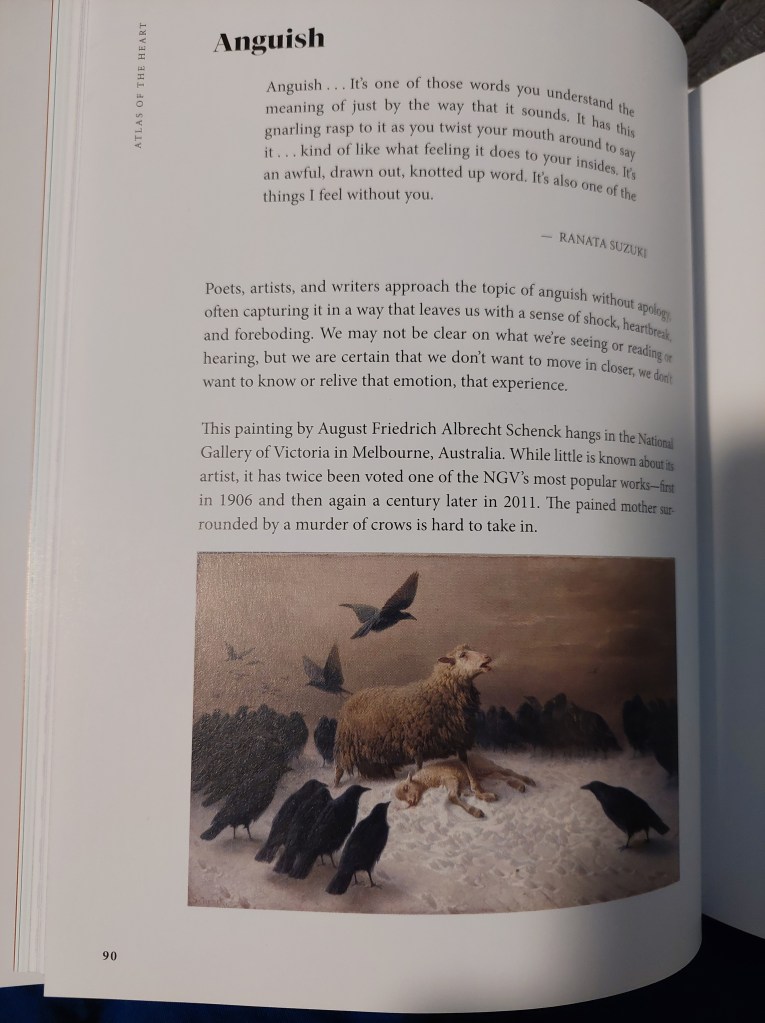
Grief and the influence it has on our lives is a huge theme of this movie. While thinking about the film, I thought about this painting I saw in Brene Brown’s book Atlas of the Heart, in which she breaks down and explains a wide range of different feelings and emotions we have in certain situations, such as belonging, joy, and anxiety. One of these is called anguish, and on page 90 she shows a painting by August Friedrich Albrecht Schneck called Anguish, which depicts a mother sheep grieving the loss of her dead lamb child, while surrounded by a group of crows. Honestly when I first saw that painting I was pretty emotional, not just because I am a huge lover of animals but because anguish and grief are very real and very painful experiences. I am not sure whether Ada ever found out that Maria killed her mother, or whether Ada’s biological father even knows either. I’m sure the movie left that up to interpretation. But that painting showed me that animals experience emotions like us, and that they’re not just these dumb unfeeling creatures. I think as I processed the film, at first I didn’t know what was going on with the sheep bleating out the window at Ada all the time, but then Petur tells Maria that if she doesn’t let him hit on her, he will tell Ada that Maria killed Ada’s mother, and that’s when I realized, Oh, shit. That was Ada’s mother. That must have been pretty painful for Ada to be so young and yet lose her mother like that. I looked up more about the Anguish painting, and there is a 1885 version in which, instead of the mother sheep grieving her young’s death, the young sheep grieves over his mother’s dead body, surrounded by the same crows.
Full credit: p. 90, Atlas of the Heart: Brene Brown. Anguish (Angoisse) (c. 1878) by August Friedrich Albrecht Schenck. National Gallery of Victoria, Melbourne, purchased 1880.
Both of these versions left my heart feeling incredibly heavy. Losing one’s parents, child or any other loved one is an incredibly painful experience, no matter how one processes grief or expresses their grief. I just think about The Writings of Nichiren Daishonin because in many of his letters he talks about grief and losing loved ones, because many of his followers dealt with the loss of their loved ones. He encourages them to continue practicing Buddhism and overcome their challenges, but he also acknowledges that grief is a human experience and is also incredibly painful, even for the most stoic of people. To be honest, I am getting pretty emotional writing about this and thinking about the Anguish painting and the film because losing people you love really does hurt, and while Ada grieved over her adoptive father (Ingvar’s) death, I wonder how she is going to be able to process learning about her mother’s death as she grows up in the future, or whether she is going to go through life not knowing that her mother got killed. It was painful for me to watch Maria grieve over her husband, Ingvar’s death, but in a way, her grief was connected to Ada’s biological mother’s grief, even if Maria just thought Ada’s mom was just some annoying dumb animal who kept making loud bleating noises at the window. Of course, I may be overthinking it. After all, these people lived on a farm, probably hours from a grocery store, and they had to get their lamb chops from somewhere (I’m saying this as someone who has been a lifelong animal lover and a vegan for fifteen years). But it is still painful because Ada’s mom’s grief at not getting her child back was not really any different from Maria’s grief at losing Ada (and Ingvar.) In the book Atlas of the Heart, Brene Brown describes the feeling of anguish in a way that just ripped at my heart strings (“anguish is an almost unbearable and traumatic swirl of shock, incredulity, grief and powerlessness.” Brown 91)
She also explains that anguish can be physically tormenting as well. When we experience anguish, we have trouble breathing, focusing, really doing anything, and it can literally make us sink into the ground. I remember when my mentor, Daisaku Ikeda, passed away. It was November 18, and my mother was going to write to him. She had worked so hard on this letter the night before, and I remember the morning I checked my phone and found on the WhatApp group the news from other SGI members about his passing, I couldn’t breathe, my heart raced and I literally felt I could not do anything. Walk, get up, go to the bathroom. Nothing. I felt a huge stone thud in my body, and my head spun and I began to feel my life was no longer in my control. Now of course you will say, Hold up. Was it really that painful? Yes. It was, reader. It very much was. I woke up to do my morning chanting of Nam-myoho-renge-kyo to my Buddhist altar, the Gohonzon, and my dad walked in and told me with a pained expression he found out the news about Daisaku Ikeda’s passing, too. My mother was going to sleep in, and I was anxiously wondering what to tell her, because I was still very much in shock, too. When we finally told her that morning, she froze, and her lips trembled and she leaned down and her body racked with sobs. She retrieved the letter she was going to send to Mr. Ikeda and read to us aloud, and as she read, she clutched her mouth to hold back the sobs as tears streamed down her cheeks and she felt like she was going to collapse. My father and I cried with her. We just were in such shock. We knew he was 95. But it was still deeply painful. We scheduled a chanting session at the Buddhist center and everyone came and was deeply pained. I remember the next morning before going to the center for my Byakuren shift reading Daisaku Ikeda’s encouragement, and still in shock, collapsing on top of the kitchen counter and emitting loud long wails as tears racked my body and I lost control of my expression of grief. My mother rubbed my shoulders as I was completely beside myself. I then went to the restroom and my shoulders heaved and heaved and I just could not stop crying. I collapses physically and I felt I wasn’t actually going to make it to the center that day. Even after I wiped my tears, the grief was still very much present, not just with me but with everyone who came to the center that day. The anguish everyone felt over the passing of our mentor was painful to witness and experience, and I remember feeling so alone in my grief until I remembered that everyone was still grappling with his passing and that grief is not something you can just rush through or push under the rug. Of course, you don’t have to let it consume you, but I have learned that everyone processes grief differently and there is no arbitrary time table for people to grieve.
I think watching movies during this time of grief has been a reminder that grief is a human experience and that I shouldn’t feel like I am going through it alone. The other day, I watched The Crown season 6 and it shows the grief that Charles experiences when he finds out that his ex-wife, Diana, died in a car crash in Paris. When he sees her body during the autopsy, he experiences serious anguish and he sees Diana in a vision as if she was still alive, and what she tells him fills him with deep regret at the way he treated her for so many years. Even after he was talking about how happy he was with Camila, Diana still had a profound impact on his life and so it was painful and shocking to find out about her death. Dodi’s dad, Mohamed Al-Fayed (who actually passed away this year) also experiences profound grief when he learns Dodi died with Diana in the car crash. At the funeral for Dodi he is in so much emotional pain and wails in anguish when he goes into the examining room and sees his son’s body after the autopsy. Mohamed also imagines Dodi talking to him, saying how he failed his father, and he breaks down and tells Dodi before he disappears that he didn’t fail him and that he really misses him. This showed me that even though Diana had a complicated and destructive marriage where Charles didn’t value or respect her, and even though Dodi had a relationship with his father where his father placed heavy expectations on him and demeaned him if he failed to meet those expectations, at the end of the day, the grief Charles and Mohamed both experienced reminded them of how much they actually loved the people they lost and how painful it was to lose the people you love.
Last week, while on break, I walked into the room and started watching TV and I came across this movie called The Intern. I had briefly heard about it but had not known anything else about it, hadn’t even seen the movie trailer. Honestly it was a really excellent movie, and it has a really heartfelt message. It is about a 70 year old widower named Ben Whitaker who lives in New York City and is happily retired but who is trying to find his purpose in life. He has tried everything: learning Mandarin, taking classes, doing tai-chi, but he is still wondering what else to do. While walking down the street he sees a flier advertising an internship program at a fashion agency for people 65 years of age and older. He decides to send in his application, which is a video cover letter (because as the ad says, traditional cover letters are so old school) and he gets an interview for the job. When Ben gets the job, he is assigned to the owner of the company, Jules Ostin (played brilliantly by Anne Hathaway, who was in another workplace comedy-drama called The Devil Wears Prada, only she was the assistant to a mean boss.) Jules is not great with elderly people and she is also super swamped with trying to run the company and also manage her family life. Ben is eager to start working immediately, and they assign him to work directly under Jules. However, Jules is not excited about working with Ben and doesn’t give him any work to do even when she tells him she will email him work to do. However, what this movie showed me is that when you are not given anything to do, sometimes you need to take the initiative yourself, and when you take the initiative you gain people’s trust. Ben shows that he is willing to put in the work, and one crucial thing he does on the job during his first few weeks is help one of the employees roll a cart of stuff through the office since she is having trouble rolling it. When Jules sees him humbly doing this for the employee, she takes note but she also still doesn’t give him much to do. However, when she arrives to work one morning she finds that this big pile of papers, junk and other stuff that was just lying in an area of the office is magically gone, and the desk where people dumped the stuff is suddenly neat. Jules wonders who did it, and her other coworkers tell her that Ben arrived early in the morning to organize the desk. Ben in his personal life is also a very organized person. He keeps his suits, his pants, his ties and his undergarments very well organized. (I was getting serious Marie Kondo vibes, and all I could think was, I need to do a serious Ben Whittaker/ Marie Kondo cleanup of my room.) They ring a bell every time something good happens at the company (getting a record number of Instagram likes, etc.) and someone rings the bell and announces Ben cleared the desk, and everyone claps and cheers. Ben is appreciative, but he is also humble, and I think I learned from Ben to always have that humble spirit and keep making sincere efforts to try and do good work even if you think people don’t see it. I think it’s a good lesson for me to learn because it’s easy for me to feel like I’m not being recognized or that my work doesn’t matter, but when people remind me how important my work is, I feel good. But I’ve also learned I need to also take ownership of my work as well and I think doing this has helped me gain more confidence in myself when I recognize that I am doing my best each day. It hasn’t been easy to do this but it is something I am still working on.
When Jules sees Ben is truly making a sincere effort in the workplace, she finds he is also helpful in many other areas of her life as well. One day she gets soy sauce on her suit jacket, and Becky, her very stressed and burned out assistant, alerts him to it. He humbly takes the jacket to get cleaned, and then he finds out of the corner of his eye when looking out the window that Jules’ personal driver is drinking alcohol before he is scheduled to drive Jules. Jules is about to go down to meet the driver, but Ben goes down to talk to the driver and he politely tells the driver that it would not be safe for him to drive Jules after he has been drinking alcohol, and he should just tell Jules he needs to call out for the day since he doesn’t feel well. The driver listens to him, and Jules lets Ben drive her to her destination. She ends up letting Ben drive her the rest of the time, and they end up developing a very special bond. However, Jules is not comfortable with this at first. She is always working and never makes time for herself, even to spend time with her husband, Matt, and young daughter, Paige. Matt is a stay at home dad who spends a lot of time with Paige, but he never gets to spend time with his wife because she is working all the time. Something about Ben makes her feel calm because he always puts her at ease with his calm presence. He never fusses nor complains about how stressed he is. He shows up and does his job, and she realizes that is all she wants is someone who can show up and take the initiative to get the job done. Without Ben knowing she orders Ben to be transferred to another department because she is suspicious about his intentions, and she doesn’t think people will take her seriously, but one day she gets in the car and finds another intern, not Ben, is driving her (the lady ends up almost crashing into a car and Jules ends up driving herself) and she goes into the office and Cameron, her VP, informs her that like she emailed, her request to transfer Ben was completed. She rushes over to a coffee shop, where she finds Ben getting coffees to take back to the office, and she apologizes and tells him that she is not used to being around someone with Ben’s calm centered down to earth personality, and she could really use his help. Ben doesn’t give her a hard time, and tells her he would be happy to work for her again. She regains his trust and this helps in much deeper situations, namely when Ben finds out that Matt is cheating on Jules. Jules reveals later to Ben that she knew he was cheating and she is fearful that if she leaves Matt she will end up alone. She is holding out hope for them to stay together, but Ben is very honest with her and tells her she needs to do what makes her happy. Jules is on a trip in San Francisco to meet with a CEO because Cameron is telling her she is doing too much, and it would help to have someone else run the company. However, this is a frightening prospect to Jules because this company is Jules’ baby. She nurtured it from start to finish, and she feels she needs to handle everything rather than ask for help in hopes of keeping the company running. However, Ben is teaching her that she needs to ask for help and that asking for help is not a sign of weakness. When Jules learns this, she learns that some other people on the team also need help as well, in particular her assistant, Becky, who is swamped with work and works 12 hours a day under all these high stress situations. Jules never acknowledged how hard Becky was working, but then Ben shows her that to keep people feeling okay about working somewhere, you need to make them feel appreciated and valued and respected. Becky has a business degree and has a valuable skillset but Jules up until then never acknowledged it, until Ben tells Jules that Becky has so much potential, especially because she helped him on a project that Jules needed help on.
The movie doesn’t talk too heavily about grief, but it is significant that the main character is a widower. He also goes to a lot of funerals. Even though I am still young, I have attended many memorial services and funerals for many of my older friends who have passed away. I am not going to lie, grief is very painful. After one of my friends passed away in April, I really didn’t know how I was going to go on with my life. She was truly a treasure and for a 20-something who was depressed and suicidal at the time, she really gave me hope that life had a great purpose and that I could become happy even when I was going through painful difficulties. I didn’t have to wait until later in life to become happy. Losing a lot of the older members in my Buddhist community has been a serious journey of healing and learning to heal from loss, but I can look back with appreciation for all of the memories I shared with my friends in the community. They really showed me that life itself is a source of joy and that I have a lot more to be thankful for than I think I do. I think studying about life and death from a Buddhist perspective has helped me create meaning from life even when I felt it was no longer worth living at times because I was going through so much painful suffering. And I think seeing the vibrant lives of so many of the older members of my Buddhist community reminded me that the pain, heartbreak, disappointment, anxiety and other stuff I was going through in my 20s was not forever, and that there was hope for me. It also showed me that it helps to have a purpose in life and meaningful relationships with people in the process of healing from loss. Ben meets a wonderful woman named Fiona, who is a masseuse at his workplace. They strike up a conversation and they end up dating and falling in love. She, like him, is an older woman and they develop a meaningful bond with each other. Ben also develops a meaningful friendship with Jules, and teaches her a lot of life lessons. He also learns from her with so much humility and grace, and even when she has to make the difficult decision about whether to move to San Francisco or not in order to leave Matt, Ben fully supports Jules in her decision because he wants her to be happy, and when he reminds Matt of this one night, Matt self-reflects and realizes what he did was wrong, and it takes a lot of courage for him to confront Jules about his cheating and tell her that he will do better.
I need to get some sleep but 0verall, this was an excellent movie. I really recommend watching it. There are also some funny moments as well, like when Ben and his coworkers have to break into Jules’ mom’s house and delete a nasty email Jules accidentally sent to her mom. The scene where Adam Devine’s character is jamming to Busta Rhymes in the car was hilarious! Overall, excellent movie.
So last evening my family and I finished the first part of season 6 of The Crown. And I was just craving another period drama, and I remembered after finishing Ted Lasso, I looked up shows that were similar to it, and there was a list of shows and one of them was The English Game. This is one of the few TV shows or movies that I walked into without knowing anything about the plot or characters. I just remembered that Julian Fellowes, the creator of Downton Abbey, created this show and I was all for it, because Downton Abbey is one of my favorite shows.
The English Game takes place in the 19th century in London, and a team of football players named The Etonians are upper class and members of the Football Association. They have credentials, influence and, above all, money. However, there are a group of paper mill workers in the working class community of Darwen who also play football, and two players from Scotland, Fergus and Jimmy, arrive in England ready to play because the cotton mill owner, James, recruits them to play so the team can win the FA Cup. However, the Old Etonians are unwilling to let these people play because they are poor and the Etonians want only rich people to play. Arthur is the leader of the Etonians and he comes face to face with Fergus, who just wants a shot at accomplishing his dreams of being a footballer. One of the messages I learned about this miniseries is that perseverance is key if you want to follow your dreams, and if you really want to follow your dreams you have to push past the rejection, the humiliation, and the criticisms from others. Fergus learns how to not give up on himself even when the going gets rough, especially in one crucial scene where James and the Cotton Club members propose wage cuts for all the workers at the cotton mills. It also puts a strain on Fergus’s teammates when they find out that Fergus and Jimmy are the only footballers on the Darwen team who are being paid to play.
The show in some ways reminded me a lot of Ted Lasso. In a later season of Ted Lasso, one of the star players on the AFC Richmond team, Sam Obisanya, is almost recruited by Edwin Akufo, who is a multimillionaire who wants Sam to play on Nigeria’s team. He bribes Sam with all sorts of material wealthy things. He even has authentic Nigerian food catered to Sam. He wants to make money off of Sam, but Sam is loyal to AFC Richmond, so he turns down the offer. Edwin gets really upset and tears Sam down, but Sam is confident in himself so he isn’t swayed by Edwin’s insults. It reminded me of The English Game a little because Fergus needs to make a tough decision whether to join John Cartwright’s team, Blackburn, or stay with the Darwen team. Even though Cartwright promises him better benefits if he goes to their team, it puts a strain on his relationships with his Darwen teammates because not only are Jimmy and Fergus getting paid to play (they weren’t supposed to get paid to play football as a rule) but they go to the rival team. When Fergus and Jimmy go to the pub to hang out, their teammates get upset and tell them to leave since they betrayed them. But after Jimmy gets injured (just a warning, the scene where you see Jimmy’s injury is pretty graphic. I didn’t see it coming though because I didn’t read much about the show before watching it) his teammates began to have more sympathy for him, and gradually Fergus regains trust with his Darwen teammates when they realize that he wasn’t going to put on airs just because he went on the Blackburn team. It also reminded me of another moment in Ted Lasso, when Nathan Shelly, who was the kit-boy on AFC Richmond’s team, was recruited by Rebecca’s ex-husband, Rupert Mannion, to join the Manchester team. After a lot of self-actualization and realizing that Rupert is not a great guy to work with, he begs the AFC Richmond team to let him back on the team again. They let him back on, but they also let him know how egotistical he acted. I think Nathan realized that he really did love AFC Richmond and felt more at home there than he did on the Manchester team.
I love the romance between Fergus and Martha Almond, as well as the romance between Jimmy and Doris. When Fergus meets Martha she doesn’t warm up to him at first because she also has a young daughter she needs to protect and she doesn’t trust anyone to help her. However, as Fergus and Martha get to know each other, they develop a deep love for one another. Jimmy and Doris hit it off really well, and they get married. Fergus tells Jimmy to focus on football, but he is so overjoyed at getting married and Fergus realizes he wants Jimmy to be happy. Fergus also realizes he really loves Martha and wants to be more than friends, but we find out that Martha was in a relationship with Mr. Cartwright, the owner of the Blackburn team that Fergus is joining, and her daughter is technically Mr. Cartwright’s kid. Mr. Cartwright wants Martha to forgive him and still wants her to love him, but that also puts a strain on his marriage. Martha encourages Fergus to persevere and not give up on himself, and they develop an incredible bond together.
I also found a lot of similarities between the show and other stuff I have watched and read. There is a character named Alma, and she is married to Arthur, who runs the Etonian football team and is on the football association board. Alma suffers a miscarriage and it seems like she has nothing left to live for because she was really looking forward to becoming a mother, but then she goes to a women’s refuge called Brockshall, and she finds herself helping out Betsy, a young woman who works with Martha but got fired from her job. Betsy has her baby, but Mrs. Cartwright, who runs the refuge, gives the baby away to an adoption agency. Alma digs at her for this information, and after a lot of teeth pulling, Mrs. Cartwright finally gives her the book with the list of children given away for adoption. Alma does everything in her power to get Betsy’s baby back, and she goes to the adoption agency herself and takes the baby away. The woman at the agency fights her, but Alma’s husband, Arthur, stops the woman and lets Alma leave with Betsy’s baby so she can give her back to Betsy. It reminded me of this movie I watched a while ago called True Mothers, a Japanese language film about a couple who adopt a child after being unable to conceive, and their later confrontation with the young mother who wants her son back from the couple. Like in The English Game, the women whose babies are taken to the agency are mostly born out of wedlock or from unwanted pregnancies, and during the 19th century there was a lot of shame and judgment associated with a woman being pregnant if she was unmarried. It reminded me, too, of the judgment Ethel encountered in the show Downton Abbey. Ethel meets a soldier named Charles Bryant when he is staying at Downton during the war, and she becomes pregnant with his child. She faces a lot of shame and stigma for having a child out of wedlock and she has to give up the child to Charles’ parents, who do not respect her.
What this movie showed me was the spirit to persevere is so important. Fergus faced a lot of challenges when competing against Arthur and the other Etonians. He and his team didn’t have as much status or wealth as they did, and they also faced financial challenges and unemployment. However, Fergus had to overcome his own self-doubt and fears in order to help lead the team to victory. He also learned that it’s okay to accept help from others, and that even though he faced a lot of painful moments in his past (his father is an alcoholic who abuses his mom and sisters) he overcame each hurdle after another. Arthur also realized that he wanted to make football accessible to everyone, not just the wealthy. I think helping Alma get Betsy her baby back may have given him a sense of purpose outside of his work or what his father expected of him. Arthur’s dad set a lot of expectations for his son, and became disappointed when he didn’t meet those expectations, but Arthur realized through working together with Fergus that football really did bring him happiness and wasn’t just something he did just to make himself look good for others.
This was overall a really good show. And the music was absolutely amazing. I found myself listening to the Downton Abbey soundtrack quite a lot these past few weeks. It just has so much incredible music and it is absolutely beautiful. Just like Downton Abbey, The English Game has amazing music as well. The music kind of reminded me of The Crown‘s music score because it sounded intense and had a somber tone, which I think was appropriate considering it was a drama. I didn’t know most of the actors in The English Game, I only knew a couple of the actors, and one was Daniel Ings because he played Prince Philip’s secretary Mike in seasons 1 and 2 of The Crown. At first it was hard to recognize him because Mike doesn’t wear a beard in The Crown, but he does when he plays the role of Francis Marindin, who was on the football board and on the Eton team in The English Game. Another actor I recognized was Kate Phillips, the actress who played Venetia Scott, Winston Churchill’s secretary, in season 1 of The Crown. She played Laura Lyttelton, the wife of one of Arthur’s close friends, and she is also Alma’s friend.
I had really been anticipating season 6 of The Crown, a really good show on Netflix I am watching right now. To be honest, this season was pretty sad. But I think watching it kind of helped me process my own grief this week after my mentor, Daisaku Ikeda, passed away this past week. Daisaku Ikeda’s encouragement really touched my life, and he was a peacebuilder and writer whose works really encouraged me, so this week after finding out he died was very painful. This first part of The Crown deals with grief and the aftermath of Princess Diana’s death, and so watching this helped me to process my own grief. I felt a lot less like I was going through this alone, and watching these episodes reminded me that grief is a universal experience and it is indeed painful to go through for everyone.
I feel bad for putting spoilers in this post but at the same time, I understand that Princess Diana’s death was very real and very painful for everyone, and while I would learn about her in history or world geography class, seeing Elizabeth Debicki embody Diana’s character so well really made me feel as if I was meeting Diana. Elizabeth is an incredible actress and I really loved her in Widows, and she is also an excellent actress in The Crown. I think when everyone was grieving Diana’s death, I think it was really sad to watch, and it showed how Diana really touched everyone’s lives, even her ex-husband, Charles. And it was also painful to watch Dodi Fayed’s father grieving because that was his only child and even though he set these high expectations for Dodi and got really disappointed when Dodi didn’t meet his expectations, he still loved his son. It was really powerful when they showed Charles imagining a dialogue between him and Diana, and then Dodi’s dad imagining him talking with Dodi. Dodi in the imagined conversation tells his dad that he failed him so many times and didn’t meet his expectations. Dodi’s father wanted Dodi to get married to Diana but it was really driven by his pursuit of wanting to become a British citizen. In the earlier episodes of season 5, Dodi’s father, as a child, encounters the abdicated Edward and his wife, Wallis Simpson, and he aspires to be British. However, he has incredibly high expectations for his son to do what he tells him to do, and Dodi is always trying to seek approval from his father. I think that is why he hangs up on his dad before telling him that he and Diana didn’t actually seal the deal on getting married because he feared his father’s disapproval. If Dodi actually told his father that Diana didn’t want to marry him, then Dodi’s father would cut him off from his fortune and basically disown his son. The imagined conversation between Dodi and his father really showed how the father regretted making his son feel poorly about himself, like he failed his father. It seems that approval seeking is a huge pattern in a lot of these relationships depicted in the show. Prince Charles wants his mom’s approval and when he speaks out for the self-determination of the people of Wales, she reprimands him for doing so. When he says he was just expressing an opinion, she shuts him down and tells him no one wants to hear his opinion. Of course, I’m sure the backstory of all this was much more complex, but as someone who has spent most of my life wanting to seek approval and reading more books about it and learning how to work on not seeking validation all the time (which is still a work in progress) it was pretty painful to see how most of the characters’ lives were based on seeking external validation. But of course, I have to remember that the royal family probably didn’t have a choice because they were in the public eye all of the time.
I think watching the scene with all the paparazzi chasing Diana was pretty sad, too. I used to think it was so glamorous to see celebrities’ photos of them taking their kids to school, eating ice cream, kissing their partners. It all seemed like these actors, musicians and other famous people were these gods or deities. I think as I grew older and started seeing more clearly what Hollywood is really like, though, I have learned that celebrities are human beings just like me. And it’s pretty stressful for a lot of them to be going about their daily lives and have someone take a photo of them and splash it all over the papers. When I went to Los Angeles, I thought, I’m going to meet all these celebrities and it’s going to be so cool! But I didn’t, and I think after reflecting on it, it was best to just let these regular ass people live their regular ass lives. I think that is why while watching the show it was so emotionally painful to see Diana being chased by the people taking the photos. They just wouldn’t give her a break, and even when Dodi and her went to get ice cream, people hounded them for photos, so much so that they had to hide in a jewelry store. Even when they go in the restaurant they set up a reservation to dine at, the people around them just stare at them and they can’t just eat in private. Diana breaks down crying because it is really stressful that she just can’t enjoy her meal with Dodi without people following her and asking her personal questions.
And it was really profound when she told Dodi that motherhood brought her the greatest joy, and it’s why I felt really sad when she died because from watching the show it was clear that she really loved her sons and they also did everything they could to make sure their mom was happy and enjoying her life even when she was dealing with these really toxic dynamics in the royal family and not having her privacy respected. In this season she goes to Bosnia to support a charity that raises awareness of landmines and how the victims of landmine explosions often go unnoticed. In the earlier seasons I saw Diana supporting many charities and organizations, and she also treated people with the utmost respect. I think that is why watching the footage that shows the thousands of flower bouquets that people dedicated to Diana really hit like a gut punch because it showed me how Diana truly touched many people’s lives. She actually wanted to go out there and be with the people.


 The Arts Are Life